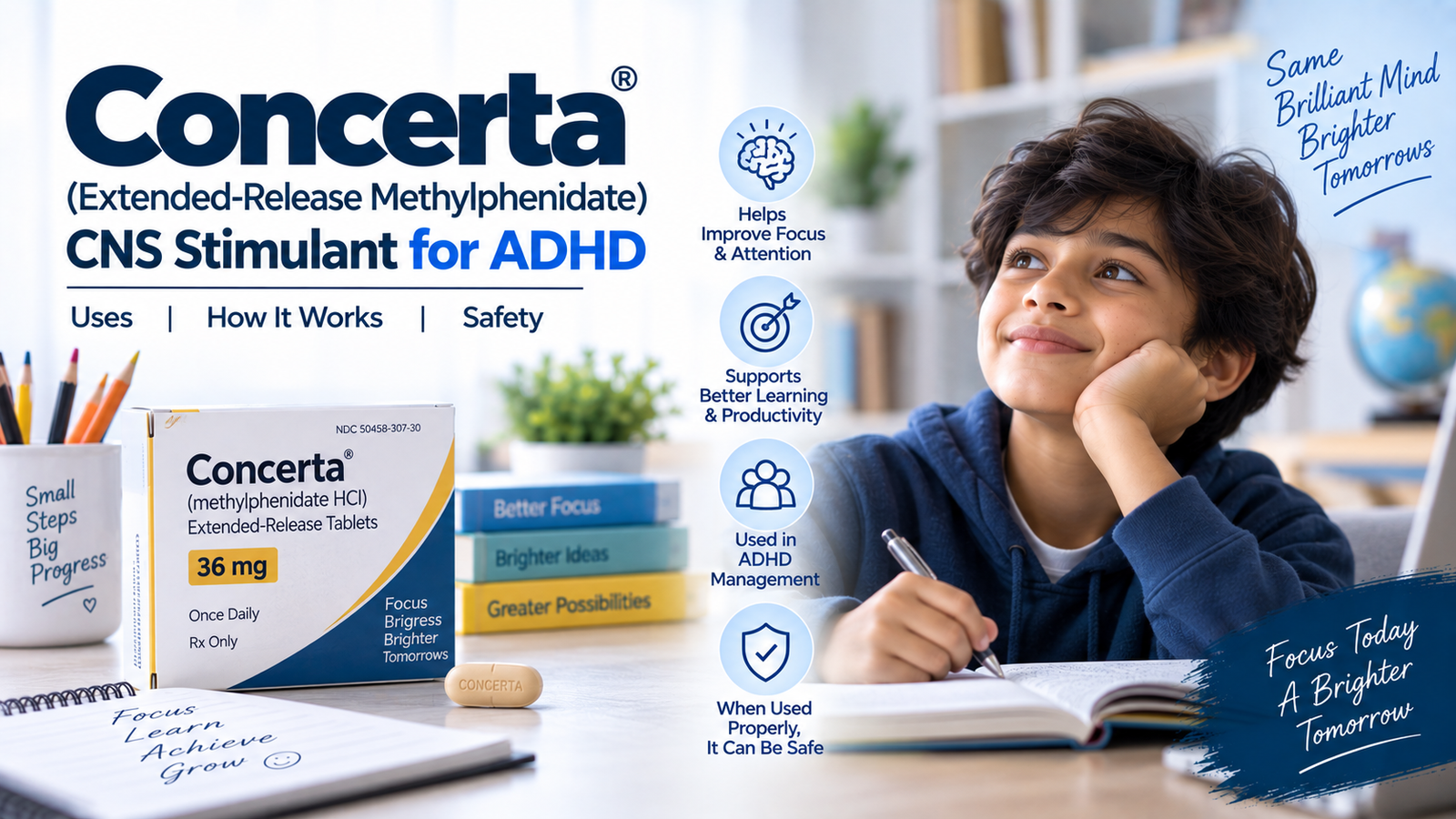
Concerta is a brand-name formulation of methylphenidate hydrochloride, an extended-release central nervous system (CNS) stimulant prescribed for attention-deficit/hyperactivity disorder (ADHD). The current U.S. prescribing information indicates Concerta for ADHD in people 6 to 65 years of age. It is designed to provide extended release of methylphenidate over the day, helping reduce ADHD symptoms such as inattention, impulsivity, and hyperactivity.
Because methylphenidate is a Schedule II controlled substance, Concerta carries important warnings concerning misuse, abuse, addiction, dependence, and overdose. It can also affect appetite, sleep, heart rate, blood pressure, and, rarely, psychiatric or cardiovascular health.

What Is Concerta?
Concerta is an extended-release oral tablet containing methylphenidate hydrochloride. Methylphenidate belongs to the CNS stimulant class and is used to control symptoms of ADHD.
ADHD is a neurodevelopmental disorder associated with persistent patterns of inattention, hyperactivity, and impulsivity that can interfere with functioning at school, work, or in everyday life.
Concerta is designed specifically as a long-acting formulation. Rather than releasing all of its methylphenidate immediately, its delivery system provides medication over an extended period.
The current U.S. label identifies Concerta as a treatment for ADHD in people 6 through 65 years of age and states that it is not recommended for children under 6.
How Does Concerta Work?
The exact mechanism by which methylphenidate produces therapeutic effects in ADHD is not completely established, but methylphenidate is a CNS stimulant that changes the levels and activity of certain natural chemicals in the brain.
MedlinePlus identifies methylphenidate as a CNS stimulant that works by changing the amounts of certain natural substances in the brain.
Methylphenidate primarily affects signaling involving dopamine and norepinephrine, neurotransmitters involved in attention, motivation, alertness, and executive functioning.
By altering these signaling pathways, methylphenidate can help some people with ADHD:
- Improve sustained attention
- Reduce impulsive behavior
- Reduce excessive hyperactivity
- Improve task completion
- Better regulate behavior
The therapeutic response varies from person to person.
What Is Concerta Used For?
Concerta for ADHD
The primary U.S. indication for Concerta is attention-deficit/hyperactivity disorder (ADHD).
ADHD symptoms can include:
Inattention
- Difficulty maintaining focus
- Easily becoming distracted
- Forgetfulness
- Difficulty organizing tasks
- Trouble completing activities
Hyperactivity
- Excessive movement
- Restlessness
- Difficulty remaining seated
- Feeling constantly driven to move
Impulsivity
- Acting without considering consequences
- Interrupting conversations
- Difficulty waiting
- Making rapid decisions without adequate consideration
Not every person with ADHD experiences all of these symptoms, and symptom patterns can change with age.
Concerta and Extended-Release Methylphenidate
One of the defining characteristics of Concerta is its extended-release formulation.
Methylphenidate is available in several formulations, including immediate-release and long-acting products. MedlinePlus notes that methylphenidate comes in multiple dosage forms and that dosing depends on the specific formulation being used.
Concerta is formulated to provide extended medication delivery rather than functioning like an immediate-release methylphenidate tablet.
This can offer a practical advantage for some patients because an extended-release medication may reduce the need for multiple doses during the day.
However, Concerta should not automatically be considered interchangeable with every other methylphenidate product. Different formulations have different release mechanisms, strengths, and prescribing instructions.
Concerta Dosage and Administration
Concerta is an extended-release tablet that is generally taken once daily in the morning according to the prescribing information.
The dosage is individualized according to factors such as:
- Age
- Previous stimulant treatment
- Clinical response
- Side effects
- Other medications
- Individual medical history
Because Concerta is an extended-release formulation, the tablet should be used according to its prescribing instructions rather than modified independently.
Do not crush or chew Concerta
The U.S. labeling specifically instructs patients to swallow Concerta tablets whole with liquid and not chew, divide, or crush them. Altering the tablet can interfere with its intended extended-release delivery.
Patients who have difficulty swallowing should discuss alternatives with their healthcare professional rather than altering the tablet themselves.
Concerta Dosage Strengths
Concerta is available in multiple strengths, allowing clinicians to adjust treatment according to individual response and tolerability.
The appropriate dose is not determined solely by age or body weight.
Healthcare professionals may adjust treatment based on:
- Improvement in ADHD symptoms
- Appetite changes
- Sleep
- Blood pressure
- Heart rate
- Mood or behavioral changes
- Other adverse effects
Patients should not increase or decrease their prescribed dose without medical guidance.
Common Concerta Side Effects
Methylphenidate products can cause side effects related to their stimulant activity.
Common concerns include:
- Decreased appetite
- Trouble sleeping
- Headache
- Stomachache
- Irritability
- Increased heart rate
- Increased blood pressure
The FDA identifies appetite loss, insomnia, headache, stomachache, irritability, increased heart rate, and elevated blood pressure among common adverse effects associated with prescription stimulants.
Not everyone experiences these effects, and their severity can vary.
Concerta and Appetite Suppression
Decreased appetite is a common concern with stimulant medications.
For children and adolescents, appetite changes can be particularly important because adequate nutrition is necessary for normal growth and development.
Healthcare professionals may monitor:
- Appetite
- Weight
- Height
- Growth patterns
- Nutritional intake
The FDA announced in 2025 that labeling for extended-release stimulant products was being updated to address a risk of weight loss in patients younger than 6 years who receive these products off-label. Extended-release stimulants, including Concerta, are not approved for ADHD treatment in children under 6.
Concerta and Sleep Problems
Because methylphenidate is a stimulant, taking it too late in the day can interfere with sleep.
Possible problems include:
- Difficulty falling asleep
- Reduced sleep duration
- Restlessness at bedtime
Concerta is generally administered in the morning to align its extended-release profile with daytime ADHD symptom management.
Persistent insomnia should be discussed with the prescribing clinician rather than prompting self-adjustment of the medication.
Concerta and Blood Pressure
Stimulant medications can increase heart rate and blood pressure.
For most patients, the changes may be modest, but some people may be more sensitive.
Healthcare professionals may monitor cardiovascular measurements before and during treatment, particularly in people with cardiovascular risk factors.
Patients should report symptoms such as:
- Chest pain
- Fainting
- Significant palpitations
- Shortness of breath during exertion
- Unexplained exercise intolerance
Concerta’s labeling contains cardiovascular warnings and recommends appropriate evaluation based on medical history and symptoms.
Concerta and Serious Cardiovascular Risks
Rare but serious cardiovascular events have been reported with stimulant medications.
The Concerta prescribing information warns about serious cardiovascular events and advises appropriate evaluation of patients with certain cardiac histories or symptoms.
Patients with known structural heart abnormalities, serious heart conditions, or other significant cardiovascular concerns should discuss these conditions with their healthcare professional before treatment.
Seek urgent medical attention for:
- Chest pain
- Fainting
- Severe shortness of breath
- Severe or sustained palpitations
- Other symptoms suggesting a serious cardiovascular event
Concerta and Psychiatric Effects
CNS stimulants can sometimes cause or worsen psychiatric symptoms.
The current Concerta Medication Guide warns about possible:
- New or worsening behavioral or thought problems
- New or worsening bipolar symptoms
- New psychotic symptoms
- New manic symptoms
Examples of psychotic symptoms may include hearing or seeing things that are not there or developing beliefs that are not based in reality.
People with a personal or family history of certain psychiatric conditions should discuss this history with their healthcare professional before starting stimulant treatment.
New or worsening psychiatric symptoms should be reported promptly.
Concerta and Misuse, Abuse, and Addiction
One of the most important safety issues associated with Concerta is its potential for misuse, abuse, addiction, and diversion.
Concerta contains methylphenidate and is classified as a Schedule II controlled substance in the United States.
The FDA requires prescription stimulant labeling to emphasize that misuse and abuse can lead to substance use disorder, addiction, overdose, and death.
Importantly, these risks are not limited to people who obtain stimulants illicitly. A person who has a legitimate prescription can still misuse the medication by taking it differently from how it was prescribed.
Never share Concerta
The FDA specifically advises patients not to share prescription stimulants with other people. Sharing can expose someone to serious adverse effects and can contribute to misuse and addiction.
Concerta should be stored securely, preferably in a location inaccessible to others.
Concerta and Physical Dependence
The current Concerta Medication Guide states that prolonged use can lead to physical dependence, even when the medicine is taken as directed by a healthcare professional.
Physical dependence and addiction are not the same thing.
Physical dependence means the body adapts to repeated exposure to a medication and may react when the medication is stopped or reduced.
Addiction involves problematic patterns of use, including impaired control and continued use despite harmful consequences.
A person taking Concerta exactly as prescribed can develop physical dependence without necessarily having an addiction.
Concerta Withdrawal and Discontinuation
Patients should not change long-term stimulant treatment without discussing it with their healthcare professional.
The appropriate approach to discontinuation can depend on:
- Duration of treatment
- Current dose
- Age
- ADHD symptoms
- Other medical conditions
- Other medications
- Individual response
Stopping a stimulant may result in changes in energy, mood, appetite, sleep, or ADHD symptoms.
A clinician can determine whether treatment should be continued, adjusted, or discontinued and whether monitoring is needed.
Concerta and Drug Interactions
Concerta can interact with certain medications.
One especially important contraindication involves monoamine oxidase inhibitors (MAOIs).
The current U.S. prescribing information states that Concerta should not be taken by people currently taking an MAOI or who have stopped an MAOI within the previous 14 days because of the potential for a dangerous interaction.
Patients should tell their healthcare professional about:
- Prescription medicines
- Over-the-counter medicines
- Antidepressants
- Blood-pressure medications
- Other stimulants
- Supplements
- Recreational substances
A complete medication list helps clinicians identify potential interactions before treatment begins.
Concerta and Other Stimulants
Concerta should not be combined with another stimulant unless specifically directed by a healthcare professional.
Taking multiple stimulant medications can increase stimulant-related effects such as:
- Increased heart rate
- Elevated blood pressure
- Anxiety
- Insomnia
- Appetite suppression
- Agitation
A clinician may intentionally use particular combinations in specialized circumstances, but this should never be done through self-directed medication changes.
Concerta in Children and Adolescents
Concerta is approved in the United States for ADHD treatment beginning at age 6. It is not recommended for children younger than 6.
For children and adolescents, clinicians may monitor:
- ADHD symptom response
- Appetite
- Weight
- Height
- Growth
- Blood pressure
- Heart rate
- Sleep
- Mood and behavior
Parents and caregivers should report significant changes in appetite, sleep, mood, behavior, or cardiovascular symptoms.
Because Concerta is a controlled substance, caregivers should also store it securely and avoid sharing medication with anyone.
Concerta in Adults
Concerta can also be prescribed to adults with ADHD. The current U.S. labeling includes adults through age 65.
Adult ADHD treatment may require particular attention to:
- Cardiovascular health
- Blood pressure
- Sleep
- Anxiety or mood conditions
- Substance-use history
- Other prescription medications
- Work and driving demands
Treatment should be evaluated based on both symptom improvement and tolerability.
Concerta and Driving
Methylphenidate can affect individuals differently.
While effective ADHD treatment may improve attention for some patients, Concerta can also cause adverse effects such as dizziness, nervousness, or other changes that could affect performance.
Patients should understand their response to the medication before driving or operating machinery.
Combining Concerta with alcohol or other substances can introduce additional safety concerns.
Concerta vs. Immediate-Release Methylphenidate
Both Concerta and immediate-release methylphenidate contain the same active drug: methylphenidate.
The major distinction is the drug-delivery formulation.
| Feature | Concerta | Immediate-release methylphenidate |
|---|---|---|
| Active ingredient | Methylphenidate | Methylphenidate |
| Formulation | Extended-release | Immediate-release |
| Main use | ADHD | ADHD and other formulation-specific indications |
| Dosing pattern | Generally once daily | May require multiple doses |
| Drug class | CNS stimulant | CNS stimulant |
| Controlled substance | Schedule II | Schedule II |
| Release profile | Extended | Shorter acting |
Different methylphenidate products should not be treated as automatically interchangeable because their release characteristics and dosing instructions differ.
Concerta vs. Adderall
Concerta contains methylphenidate, while Adderall contains amphetamine salts.
Both are CNS stimulant medications used in ADHD treatment, but they belong to different stimulant families.
The FDA identifies Concerta/methylphenidate and Adderall/amphetamine-dextroamphetamine among common prescription stimulants used for ADHD.
Differences include:
- Active drug
- Pharmacologic profile
- Formulation
- Duration
- Side-effect patterns
- Individual treatment response
A healthcare professional determines which medication and formulation are appropriate for an individual patient.
Concerta and ADHD Treatment Beyond Medication
Medication is only one component of ADHD management.
Depending on age and individual needs, comprehensive ADHD treatment may include:
- Behavioral interventions
- Psychotherapy
- Organizational strategies
- Educational accommodations
- Parent-focused behavioral approaches
- Workplace accommodations
- Medication
The appropriate treatment plan depends on the individual’s age, symptoms, functional difficulties, coexisting conditions, and treatment goals.
Safe Storage and Disposal of Concerta
Because Concerta is a Schedule II controlled substance, secure storage is particularly important.
The FDA recommends that prescription stimulants be stored securely and that unused medication be disposed of appropriately rather than shared or kept where others can access it.
Patients should:
- Keep Concerta in a secure location.
- Never give it to another person.
- Keep it away from children.
- Avoid leaving it accessible to visitors.
- Follow appropriate medication take-back or disposal instructions.
When to Seek Urgent Medical Attention
Seek urgent medical care if someone taking Concerta develops:
- Chest pain
- Fainting
- Severe shortness of breath
- Severe or unusual heart symptoms
- Severe agitation or confusion
- Hallucinations
- New manic symptoms
- Severe psychiatric changes
- Signs of stimulant overdose
If an overdose or serious adverse reaction is suspected, contact emergency medical services or a poison-control service promptly.
Frequently Asked Questions About Concerta
What is Concerta used for?
Concerta is an extended-release methylphenidate CNS stimulant used to treat ADHD in people 6 to 65 years old under current U.S. labeling.
Is Concerta the same as methylphenidate?
Concerta contains methylphenidate hydrochloride as its active ingredient. Concerta is specifically an extended-release formulation of methylphenidate.
Is Concerta a stimulant?
Yes. Methylphenidate is a central nervous system stimulant.
Is Concerta addictive?
Concerta has a potential for misuse, abuse, addiction, and physical dependence. The FDA requires prominent warnings about these risks for prescription stimulants.
Can Concerta be crushed?
The U.S. prescribing information instructs patients to swallow Concerta tablets whole and not chew, divide, or crush them because doing so can interfere with the extended-release formulation.
Does Concerta reduce appetite?
It can. Decreased appetite is a recognized adverse effect of stimulant treatment and may be particularly important to monitor in children and adolescents.
Can Concerta increase blood pressure?
Yes. Prescription stimulants can increase blood pressure and heart rate, which is why cardiovascular monitoring may be appropriate during treatment.
Can Concerta cause insomnia?
Yes. Difficulty sleeping is a recognized potential stimulant side effect. Morning administration of the extended-release product is part of its labeled administration approach.
Can children take Concerta?
Concerta is approved for ADHD in people 6 years and older under current U.S. labeling. It is not recommended for children under 6.
Can Concerta be taken with an MAOI?
No. The current U.S. labeling contraindicates Concerta in patients taking an MAOI or who have discontinued an MAOI within the preceding 14 days.
Is Concerta a controlled substance?
Yes. Concerta is a Schedule II controlled substance in the United States because methylphenidate has potential for abuse, misuse, and dependence.
Medical Disclaimer
This article is intended for educational and informational purposes only and does not replace professional medical advice, diagnosis, or treatment. Concerta is a prescription Schedule II controlled substance with potential risks including misuse, addiction, dependence, cardiovascular effects, psychiatric effects, and overdose. Do not change the dose, crush or alter the extended-release tablet, share the medication, or stop treatment without guidance from a qualified healthcare professional.
If severe chest pain, fainting, serious breathing problems, severe psychiatric symptoms, or suspected overdose occurs, seek urgent medical attention.
Recommended U.S. Sources
- U.S. Food and Drug Administration (FDA): Current Concerta prescribing information and Medication Guide, including indications, contraindications, warnings, administration, and controlled-substance status.
- MedlinePlus / U.S. National Library of Medicine: Methylphenidate information covering ADHD, formulations, administration, and medication safety.
- FDA: Prescription stimulant safety information concerning misuse, abuse, addiction, overdose, diversion, storage, and disposal.
- FDA: Standardized safety-labeling updates for methylphenidate and other prescription stimulants.