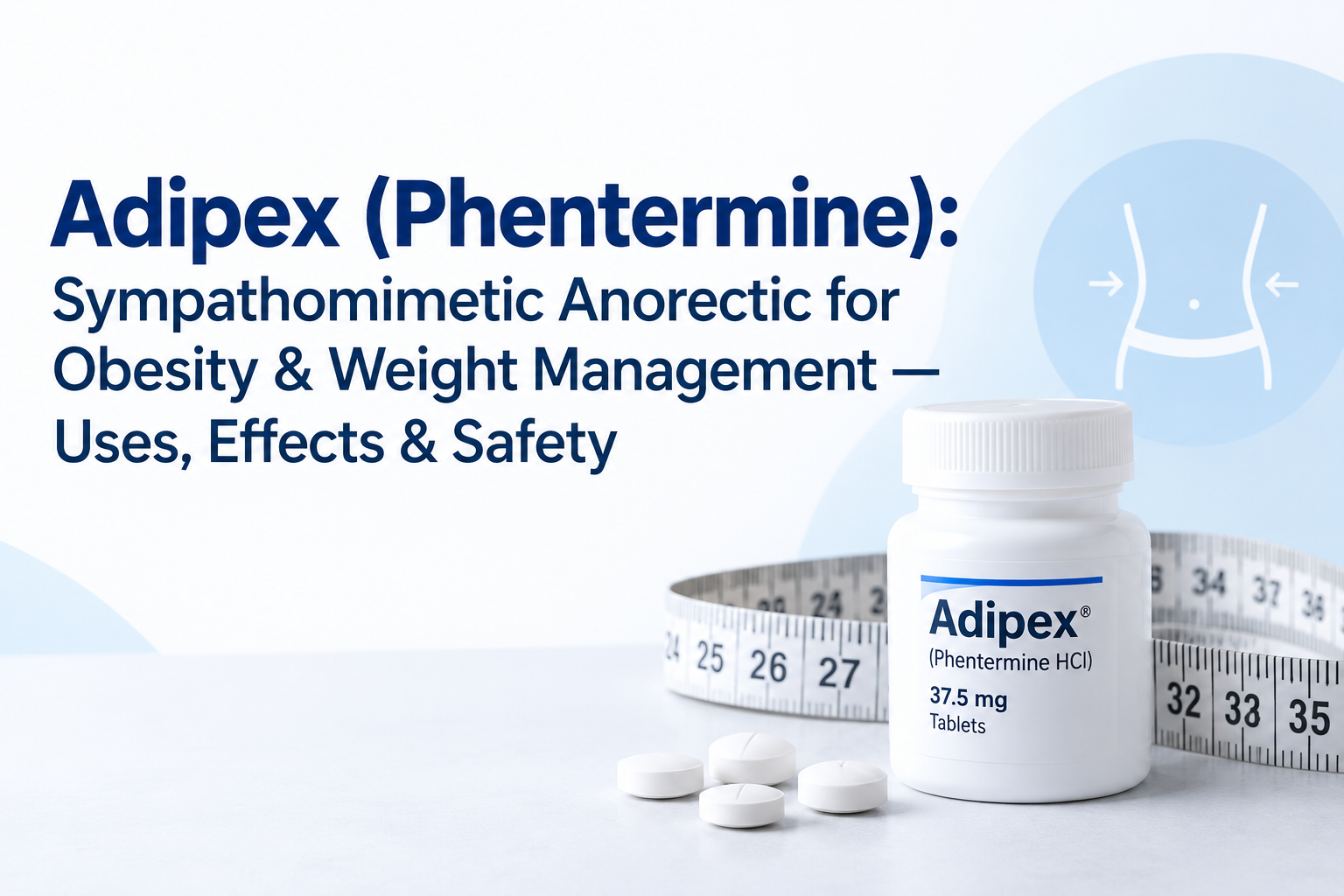

What Is Adipex (Phentermine)?
Adipex-P, commonly referred to as Adipex or phentermine, is a prescription medication used as a short-term aid in weight reduction for certain adults with obesity or overweight accompanied by weight-related risk factors.
Phentermine belongs to a group of medications known as sympathomimetic amine anorectics. In simple terms, it is an appetite suppressant that can help reduce hunger while it is being used as part of a broader weight-management plan.
In the United States, the prescribing information for Adipex-P indicates that it is intended as a short-term adjunct—generally described as a few weeks—to exercise, behavioral modification, and caloric restriction for adults with an initial body mass index (BMI) of at least 30 kg/m², or at least 27 kg/m² when certain risk factors such as controlled hypertension, diabetes, or hyperlipidemia are present.
This distinction is important because Adipex is not simply a general-purpose weight-loss supplement. It is a prescription medication with specific contraindications, warnings, potential drug interactions, and risks that need to be evaluated by a healthcare professional.
Quick answer: Adipex (phentermine) is a prescription sympathomimetic appetite suppressant approved in the U.S. for short-term use as part of a weight-reduction program for certain adults with obesity or overweight plus associated risk factors.
Is Adipex the Same as Phentermine?
Yes, with an important distinction.
Phentermine is the generic drug name, while Adipex-P is a brand-name formulation containing phentermine hydrochloride.
The U.S. Adipex-P labeling identifies the active ingredient as phentermine hydrochloride. The tablets contain 37.5 mg of phentermine hydrochloride, equivalent to 30 mg of phentermine base.
Other phentermine products and formulations may have different strengths, dosage forms, or prescribing instructions. Therefore, patients should not assume that every product containing phentermine is identical to Adipex-P.
This distinction can be useful when researching generic versus brand-name medications, comparing prescriptions, or discussing phentermine alternatives with a healthcare professional.
How Does Phentermine Work for Weight Loss?
Phentermine works primarily by reducing appetite.
The medication affects the central nervous system and belongs to the sympathomimetic amine class. Its appetite-suppressing effect can make it easier for some patients to follow a reduced-calorie eating plan.
MedlinePlus describes phentermine as an anorectic medication that works by decreasing appetite and notes that it is intended to be used for a limited period alongside diet and exercise.
The goal is therefore not simply to make someone lose weight because they are taking a pill. Instead, the medication is intended to support a broader weight-management strategy.
A typical treatment approach may include:
- A reduced-calorie eating plan
- Increased physical activity
- Behavioral changes
- Regular weight monitoring
- Follow-up with a healthcare professional
- Medication when clinically appropriate
The National Institute of Diabetes and Digestive and Kidney Diseases (NIDDK) notes that healthcare professionals commonly use lifestyle changes as the foundation of overweight and obesity treatment, while weight-loss medicines may be considered when lifestyle changes alone are not sufficient.
What Is Adipex Used For?
The primary use of Adipex-P is short-term weight reduction in certain adults with obesity or overweight and additional risk factors.
According to U.S. prescribing information, Adipex-P is indicated for adults with:
- An initial BMI of 30 kg/m² or higher, or
- An initial BMI of 27 kg/m² or higher when other risk factors are present.
Examples of relevant risk factors in the prescribing information include controlled hypertension, diabetes, and hyperlipidemia.
Importantly, BMI is only one part of a clinical assessment. A healthcare professional may also consider a person’s medical history, current medications, cardiovascular risk, metabolic health, lifestyle, and previous attempts at weight management.
Adipex should therefore not be viewed as a medication for cosmetic weight loss alone.
Adipex and Obesity Management
Obesity is a complex chronic condition influenced by numerous biological, behavioral, environmental, and socioeconomic factors.
Losing excess weight can potentially improve several obesity-related health risks. NIDDK notes that overweight and obesity are associated with conditions including type 2 diabetes, heart disease, stroke, and certain cancers.
Because obesity is multifaceted, treatment often requires more than one strategy.
Weight-management medications may be considered alongside lifestyle interventions for appropriately selected patients. However, different medications work in different ways, have different safety profiles, and may be approved for different durations.
This is particularly relevant when comparing phentermine with newer long-term anti-obesity medications. NIDDK reported in 2025 that several medications are now FDA-approved for long-term weight management, highlighting the expanding range of treatment options available to patients.
How Is Adipex Usually Taken?
The appropriate dose of phentermine depends on the specific product, formulation, patient characteristics, and prescribing instructions.
For Adipex-P, the prescribing information states that the dosage should be individualized to obtain an adequate response using the lowest effective dose. Late-evening administration should be avoided because of the potential for insomnia.
Patients should take phentermine exactly as prescribed and should not increase the dose or frequency without medical guidance.
MedlinePlus similarly advises patients not to take a larger dose, take the medicine more often, or use it longer than directed by their healthcare professional.
Because different phentermine products may have different formulations and strengths, information about one product should not automatically be applied to another.
How Long Can You Take Phentermine?
One of the most important characteristics of Adipex-P is that its U.S. labeling specifies short-term use, described as a few weeks.
This differs from several newer anti-obesity medications that have been specifically approved for longer-term weight management.
MedlinePlus notes that many people take phentermine for approximately 3 to 6 weeks, although the duration depends on individual response and the healthcare professional’s instructions.
Patients should not extend treatment independently simply because they continue to want to lose weight.
If a person needs long-term obesity treatment, a healthcare professional may evaluate whether another medication, continued lifestyle intervention, or another treatment strategy is more appropriate.
Common Side Effects of Phentermine
Like other prescription medications, phentermine can cause side effects.
Commonly reported effects include:
- Dry mouth
- Unpleasant taste
- Constipation
- Diarrhea
- Vomiting
- Restlessness
- Insomnia
- Dizziness
- Tremor
- Headache
- Increased heart rate or palpitations
The Adipex-P prescribing information lists adverse effects involving cardiovascular, central nervous system, gastrointestinal, allergic, and endocrine systems.
Not everyone experiences these effects, and their severity can vary.
Patients should tell their healthcare professional about persistent, severe, or unusual symptoms.
Serious Adipex Side Effects and Warning Signs
Some symptoms require prompt medical attention.
The Adipex-P label warns about potentially serious cardiovascular and pulmonary effects. Rare cases of primary pulmonary hypertension and serious regurgitant cardiac valvular disease have been reported.
Patients should seek medical evaluation for new or unexplained symptoms such as:
- Shortness of breath
- Chest pain or angina
- Fainting
- Swelling of the legs or ankles
- Significant deterioration in exercise tolerance
- Significant heart palpitations
These symptoms should not simply be assumed to be normal effects of an appetite suppressant.
The prescribing information specifically instructs that Adipex-P should be discontinued and the patient evaluated if new, unexplained symptoms suggestive of pulmonary hypertension occur.
Who Should Not Take Adipex?
Adipex-P is contraindicated in certain situations.
According to the U.S. prescribing information, contraindications include:
- A history of cardiovascular disease
- Uncontrolled hypertension
- Hyperthyroidism
- Glaucoma
- Agitated states
- A history of drug abuse
- Pregnancy
- Nursing
- Certain hypersensitivity reactions to sympathomimetic amines
- Use of monoamine oxidase inhibitors (MAOIs) within the preceding 14 days
This list illustrates why phentermine should only be used under appropriate medical supervision.
A healthcare professional should know about existing medical conditions, prescription medicines, over-the-counter products, supplements, and previous medication reactions before prescribing it.
Phentermine and Heart Health
Because phentermine is a sympathomimetic medication, cardiovascular considerations are particularly important.
The Adipex-P label contraindicates its use in patients with a history of cardiovascular disease, including coronary artery disease, stroke, arrhythmias, congestive heart failure, and uncontrolled hypertension. It also advises caution even in patients with mild hypertension because blood pressure may increase.
Patients with a history of high blood pressure, heart rhythm problems, heart disease, or other cardiovascular conditions should discuss these issues with their healthcare professional before considering phentermine.
Phentermine Drug Interactions
Phentermine can interact with other medications.
One of the most important interactions involves monoamine oxidase inhibitors (MAOIs).
The Adipex-P prescribing information states that the medication is contraindicated during or within 14 days after treatment with an MAOI because of the risk of a hypertensive crisis.
The label also identifies considerations involving:
- Alcohol
- Insulin
- Oral diabetes medications
- Adrenergic neuron-blocking drugs
- Other weight-loss medications
- Certain serotonergic agents
The prescribing information states that combining Adipex-P with other weight-loss products has not been established as safe and effective and is therefore not recommended.
Patients should provide their complete medication and supplement list before beginning treatment.
Can You Take Phentermine With Other Weight-Loss Medicines?
Patients should not combine phentermine with another weight-loss medication unless specifically directed and clinically evaluated by their healthcare professional.
The Adipex-P label describes the drug as short-term monotherapy for the management of exogenous obesity and states that the safety and efficacy of combination treatment with other weight-loss drugs, over-the-counter preparations, herbal products, or certain serotonergic agents have not been established.
This is especially important as modern obesity treatment includes medications from several different classes, including GLP-1 receptor agonists and other therapies.
A medication that is appropriate for one patient may be inappropriate for another because of medical history, concurrent medications, treatment goals, or adverse-effect risk.
Is Adipex a Controlled Substance?
Yes.
Adipex-P is labeled as a Schedule IV controlled substance in the United States.
The prescribing information also warns about the potential for abuse and dependence.
This does not mean that every patient who receives phentermine will develop dependence. However, it reinforces why patients should use the medication only as prescribed and should not share it with another person.
Phentermine should be stored securely and kept out of reach of children and others who might misuse it.
Adipex, Pregnancy and Breastfeeding
Adipex-P should not be used during pregnancy.
The prescribing information states that Adipex-P is contraindicated during pregnancy because weight loss provides no potential benefit during pregnancy and may cause fetal harm. It is also contraindicated during nursing according to the labeling.
Anyone who is pregnant, planning pregnancy, or breastfeeding should discuss medication use with an appropriate healthcare professional.
Weight-management treatment during pregnancy requires a different clinical approach and should not be based on the weight-loss goals used outside pregnancy.
Adipex and Kidney Function
Kidney function can also affect the safe use of Adipex-P.
The current labeling specifies a maximum dosage of 15 mg daily for patients with severe renal impairment, defined in the label as an estimated glomerular filtration rate (eGFR) of 15–29 mL/min/1.73 m². It recommends avoiding Adipex-P in patients with eGFR below 15 mL/min/1.73 m² or end-stage renal disease requiring dialysis.
This makes it important for patients with kidney disease to disclose their condition before treatment.
Adipex vs. Newer Weight-Loss Medications
The obesity-treatment landscape has changed substantially.
Phentermine is an established short-term appetite suppressant, while newer medications may be approved specifically for longer-term weight management.
For example, NIDDK’s updated information notes that multiple medications are now FDA-approved for long-term weight management.
Newer treatments can include medications affecting appetite regulation and metabolic pathways, such as GLP-1 receptor agonists and dual GIP/GLP-1 receptor agonists.
This does not mean that one category is automatically better for every patient.
The appropriate choice depends on factors such as:
- BMI
- Existing health conditions
- Cardiovascular risk
- Diabetes status
- Other medications
- Previous weight-loss attempts
- Side-effect considerations
- Cost and access
- Treatment duration
- Patient preferences
A healthcare professional can help determine which obesity treatment option is appropriate.
Does Adipex Work Without Diet and Exercise?
Adipex is not intended to replace healthy eating or physical activity.
Its U.S. labeling specifically describes it as an adjunct to a regimen involving exercise, behavioral modification, and caloric restriction.
NIDDK likewise emphasizes lifestyle changes as a central component of weight management. Healthy eating and physical activity can help reduce calorie intake, increase energy expenditure, and support long-term weight management.
Therefore, the most useful way to think about phentermine is as one component of a medically supervised weight-management plan, rather than a standalone solution.
Frequently Asked Questions About Adipex and Phentermine
What is Adipex used for?
Adipex-P is used as a short-term adjunct to diet, exercise, behavioral modification, and caloric restriction for certain adults with obesity or overweight plus specified risk factors.
Is Adipex the same as phentermine?
Adipex-P is a brand-name product containing phentermine hydrochloride. Phentermine is the generic drug name.
How does phentermine help with weight loss?
Phentermine primarily works as an appetite suppressant. By reducing hunger, it may help some patients follow a reduced-calorie eating plan.
How long is phentermine usually used?
U.S. labeling for Adipex-P describes treatment as short-term, generally a few weeks. Individual treatment duration should be determined by a healthcare professional.
What are common phentermine side effects?
Commonly reported effects include dry mouth, unpleasant taste, constipation, diarrhea, vomiting, restlessness, dizziness, tremor, and insomnia.
Can people with high blood pressure take Adipex?
Not everyone with hypertension is an appropriate candidate. Adipex-P is contraindicated in uncontrolled hypertension and requires caution even with mild hypertension because it can increase blood pressure.
Can you take Adipex during pregnancy?
No. Adipex-P is contraindicated during pregnancy.
Is phentermine addictive?
Phentermine is a Schedule IV controlled substance and carries a risk of abuse and dependence. It should be used only according to the prescription and under medical supervision.
The Bottom Line
Adipex (phentermine) is an established prescription appetite suppressant used for short-term weight reduction in appropriately selected adults with obesity or overweight and additional risk factors.
Its role is different from that of newer medications approved for long-term obesity management. Adipex is intended to complement caloric restriction, physical activity, and behavioral modification, rather than replace them.
Because phentermine can affect cardiovascular function, sleep, appetite, and the central nervous system—and because it has important contraindications and drug interactions—it should be used only under appropriate medical supervision.
Anyone considering Adipex should discuss their BMI, medical history, blood pressure, cardiovascular health, kidney function, current medications, pregnancy or breastfeeding status, and weight-management goals with a healthcare professional before treatment.
Most importantly, a prescription weight-loss medication should be viewed as part of a broader, individualized approach to obesity care rather than as a quick or standalone solution.
Medical Disclaimer
This article is intended for general educational and informational purposes and is not a substitute for professional medical advice, diagnosis, or treatment. Medication information can change, and individual treatment decisions should be made with a qualified healthcare professional using the most current prescribing information. Do not start, stop, combine, or change the dose of phentermine or any other prescription medication without appropriate medical guidance.