
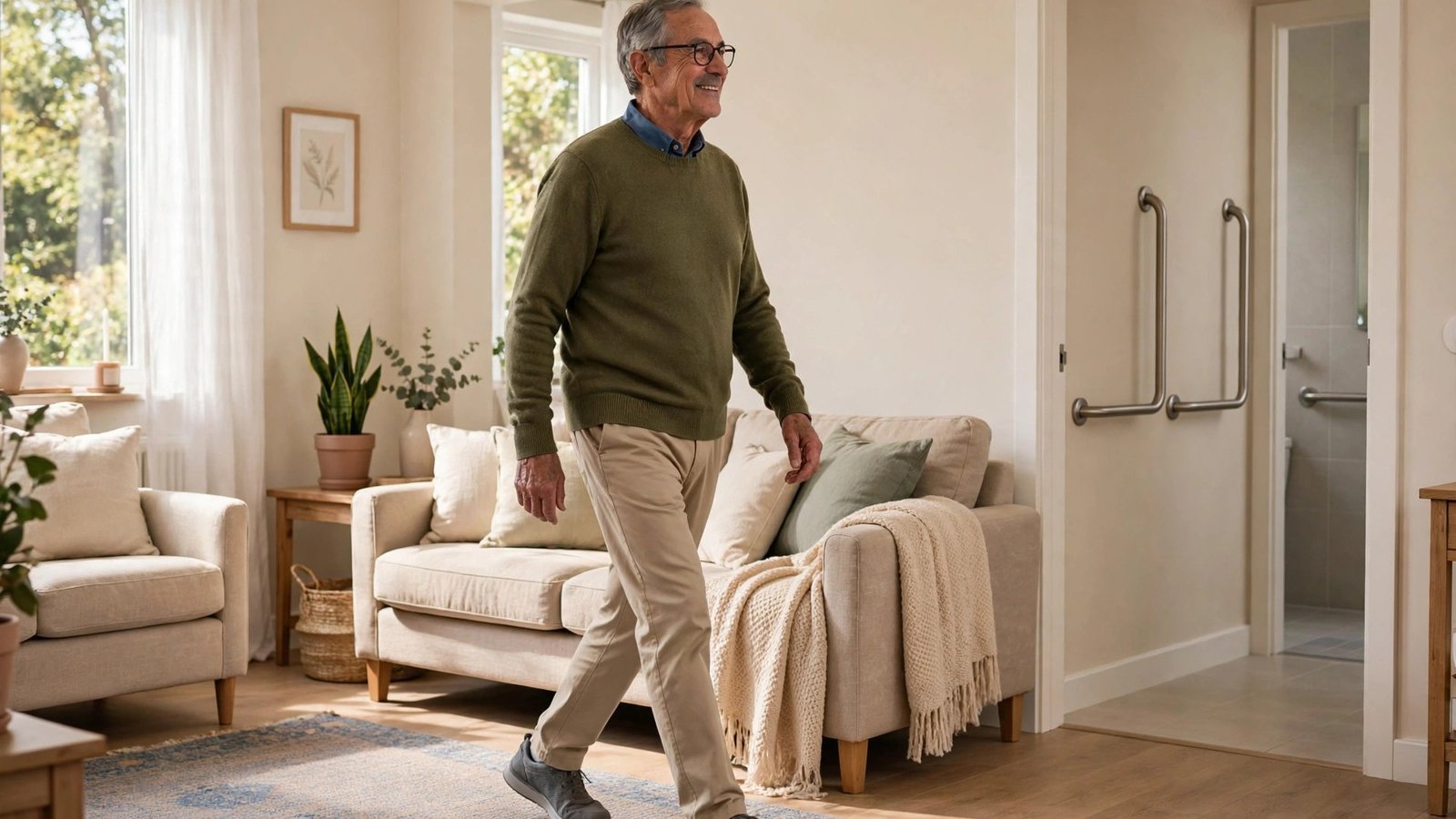
Fall Prevention for Seniors at Home: A Room-by-Room Safety Checklist for Ages 60–80
Most falls at home are preventable, and the fixes are often simpler than people expect: remove the loose rug, add a grab bar, improve the lighting, wear supportive shoes, and get your balance, vision and medicines checked. This room-by-room checklist walks you through your whole house — bathroom, kitchen, bedroom, living areas, stairs and outdoors…
Most falls at home are preventable, and the fixes are often simpler than people expect: remove the loose rug, add a grab bar, improve the lighting, wear supportive shoes, and get your balance, vision and medicines checked. This room-by-room checklist walks you through your whole house — bathroom, kitchen, bedroom, living areas, stairs and outdoors — so you can spot hazards in one afternoon and fix the highest-risk ones first. If you have fallen before, feel unsteady, or worry about falling, start with the three risk questions below and bring the answers to your next doctor visit.
Why falls happen — and why home safety is only part of the answer
The Centers for Disease Control and Prevention (CDC) reports that more than one in four adults aged 65 and older falls each year, and falls are a leading cause of injury in older adults. A fall is rarely caused by one thing alone. It is usually a combination: a slippery floor plus poor lighting, a new medicine that causes dizziness plus a step you did not see, weaker leg muscles plus a loose cord across a hallway.
That is actually good news. It means you do not need to fix everything at once, and you do not need to turn your home into a hospital. Each risk factor you reduce — a hazard removed, a balance exercise practiced, a medicine reviewed — lowers your overall risk a little more. The CDC’s STEADI initiative (Stopping Elderly Accidents, Deaths & Injuries) frames this the same way: screen for risk, assess what is changeable, and intervene with practical steps.
A useful mindset is this: your home should work with your body as it is today, not as it was at 40. That is not giving up independence. It is protecting it. A grab bar is not a sign of frailty; it is a handrail for a wet floor, the same logic as a handrail on stairs.
First, check your personal fall risk: three questions
Before you walk the house, answer these three questions honestly. The CDC uses them as a quick screen, and a “yes” to any one of them means you should talk with your doctor or another clinician about a fuller fall-risk check:
- Have you fallen in the past year?
- Do you feel unsteady when standing or walking?
- Are you worried about falling?
Also note: Do you need to use your hands to push yourself out of a chair? Do you ever feel dizzy when you stand up quickly? Have you started a new medicine recently? Write the answers down. They are useful at a checkup and especially at a Medicare Annual Wellness Visit, where fall-risk screening is part of the conversation. Our guide to that visit explains what doctors check and how to prepare: Medicare Annual Wellness Visit.
If you have fallen and hit your head, cannot get up, have severe pain, or notice new confusion, weakness, or bleeding, call 911 or your local emergency number right away. Do not try to “wait and see” with a head injury or a possible fracture.
The bathroom: start here, because this is where most serious home falls happen

The bathroom combines water, smooth surfaces, stepping over a tub edge, and standing up from a low seat. It deserves your attention first, even before the kitchen or stairs.
- Grab bars, not towel rails. Install sturdy grab bars beside the toilet and inside and outside the shower or tub. A towel bar will pull out of the wall if you grab it during a slip; a properly anchored grab bar will not. If you rent, ask about suction or clamp options, but know their limits — a professionally installed bar is far safer.
- Sit to shower when you need to. A shower chair and a handheld showerhead remove the need to stand on a wet surface while turning, reaching or closing your eyes against water. Sit down before you turn the water on.
- Non-slip surfaces. Use a non-slip mat inside the tub or shower and a non-slip rug or mat outside it. Replace mats whose backing has worn smooth, and never use a folded towel as a bath mat.
- Raise the toilet seat if standing is hard. A raised seat with arms reduces the effort — and the wobble — of sitting and standing. It is a small change that makes a daily task much safer.
- Keep essentials within reach. Soap, shampoo, towels and medicines should be reachable without climbing, stretching over the tub, or standing on tiptoe. A small shelf or caddy at shoulder height beats a high cabinet.
- Light it well. A bright, glare-free light and a night-light for nighttime trips matter as much as any bar. If you get up at night, you should never have to cross a dark bathroom.
Work through this room with fresh eyes: stand in the doorway and ask, “If the floor were wet and I were half asleep, what would I grab, step on, or trip over?” Fix those things first.
The kitchen: the room where multitasking causes trouble
Kitchen falls often happen while carrying something, reaching overhead, or turning quickly with wet hands. Slow the routine down and redesign the reach, not your effort.
- Move daily items to waist-to-shoulder height. Plates, cups, pans you use every day and staple foods belong where you can reach them without a step stool or a deep bend. Reserve high shelves for things you rarely use, and ask for help with those.
- Retire the step stool for everyday tasks. If you must use one, choose a sturdy stool with a handrail and non-slip steps, never a chair, and never while alone if you feel unsteady. Better still, rearrange so the stool is rarely needed.
- Clean spills immediately and wear closed-back shoes. Water, oil and dropped food on a smooth kitchen floor are classic hazards. Keep a paper towel or cloth within reach, and avoid walking in socks on hard floors.
- Sit for long prep work. Peeling vegetables, sorting mail at the counter or waiting for a pot to boil can all be done seated on a sturdy chair or stool. Fatigue makes falls more likely, so do not stand through a long task out of habit.
- Clear the traffic path. Keep the route between sink, stove and refrigerator free of pet bowls, bags, cords and small rugs. If a rug must stay, tape it down or use a non-slip pad underneath — and remove any rug with curled edges.
- Good lighting over work areas. Under-cabinet lights or a bright overhead light help you see spills, steps and edges. Replace dim bulbs rather than working around them.
A practical test: carry a pretend load — a plate in each hand — through your normal kitchen route. Where do you turn sharply, step over something, or reach? Those are your fixes.
The bedroom: make the first and last steps of the day the safest
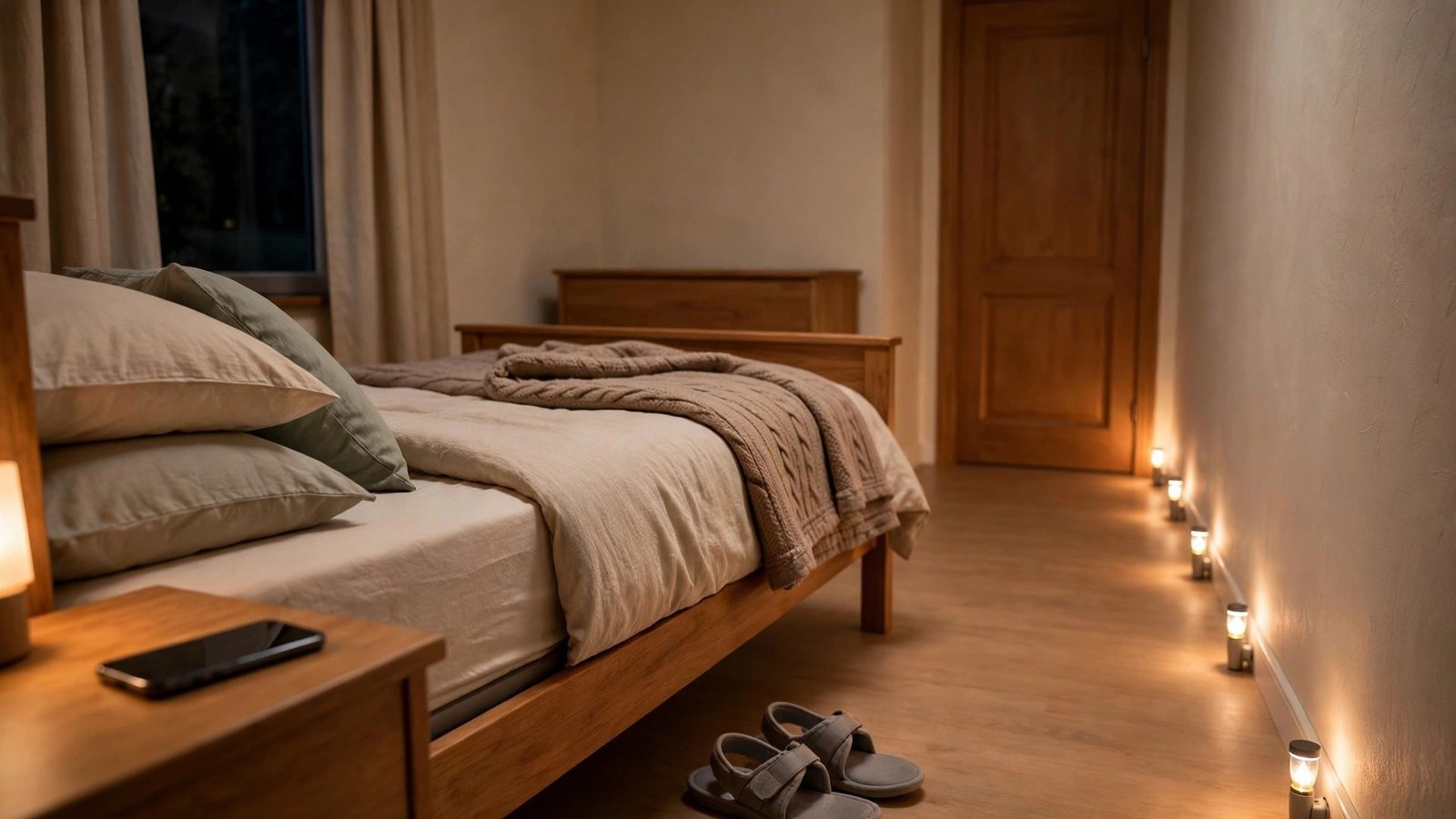
Many falls happen at night or first thing in the morning, when you are groggy, your blood pressure may dip on standing, and the room is dark.
- Light the path to the bathroom. Motion-sensor night-lights along the bed-to-bathroom route, plus a bedside lamp you can switch on without getting up, remove the most dangerous nighttime guesswork. Keep the path itself clear — no shoes, books, cords or laundry baskets on the floor.
- Set the bed at a comfortable height. When you sit on the edge, your feet should rest flat on the floor and your knees should be at about a right angle. A bed that is too high makes getting down risky; one that is too low makes standing up a struggle. Bed risers or a different mattress thickness can adjust this without buying a new bed.
- Keep supportive footwear and a phone within reach. Put firm, low-heeled, closed-back shoes or slippers with non-slip soles beside the bed — not loose, backless slippers. Keep a phone, glasses and, if you use one, a personal alarm within arm’s reach.
- Sit, dangle, stand. If you feel dizzy on standing, use a slow routine: sit up, dangle your legs for a few seconds, then stand and pause before walking. Tell your doctor if dizziness on standing happens often; it can be linked to medicines, dehydration or blood pressure changes, and it is worth checking rather than enduring.
- Dress seated when you can. Sitting on the bed or a chair to put on socks, shoes and trousers removes the one-legged balancing act that causes many bedroom falls.
Living areas: clear paths, firm furniture, no surprises
Living rooms and hallways look safe because they are familiar — and that familiarity is exactly why hazards hide there.
- Remove or secure throw rugs. This is the single most common home hazard. If a rug is not essential, roll it up. If you keep it, use a non-slip pad and make sure the edges lie flat. Rugs on polished floors are a particular risk.
- Arrange furniture for clear, wide paths. You should be able to walk through every room without turning sideways, stepping around a coffee table corner, or squeezing past a chair. Keep pathways at least wide enough for comfortable walking, and keep cords — lamps, chargers, extension leads — against walls, not across walkways.
- Choose firm, stable furniture to lean on. A wobbly side table or a rolling chair is not support. If you steady yourself on furniture, make sure it is heavy, stable and at a height you can grip comfortably. Consider replacing a low, soft armchair that is hard to get out of with a firmer chair with arms.
- Watch thresholds and level changes. A small step between rooms, a raised door threshold, or a sunken living room can trip even a careful walker. Mark the edge with contrasting tape or a bright strip if it is hard to see, and keep that area well lit.
- Pet safety, kindly. Pets are wonderful company, and small dogs and cats underfoot are a real trip risk. A bell on a collar, keeping pets out of stairwells, and training them not to walk between your feet can help. If you use a walker, check that a pet cannot get tangled in it.
Stairs and hallways: handrails, lighting, and never carrying more than you can manage

Stairs deserve respect at any age. After 60, the margin for a misstep shrinks, so the setup has to be better, not your luck.
- Handrails on both sides, if possible. A single rail is good; two rails let you steady yourself with whichever hand is free and give you support on the way up and down. Rails should run the full length of the stairs and be easy to grip — round, smooth, and firmly fixed.
- Light every step. Bright lighting at the top and bottom, plus a light switch at both ends, means you are never climbing in shadow. Motion-sensor lights on stairwells are a simple upgrade for nighttime trips.
- Keep stairs clear and in good repair. No books, shoes, laundry or boxes stored on steps — even “just for a minute.” Fix loose carpet, worn treads and broken nosings promptly, and use non-slip treads on smooth wooden stairs.
- Go slowly, one step at a time, and use the rail every time. Hold the rail even when you feel fine; that is when it becomes a habit for the day you need it. Carry items in a bag or backpack so one hand stays free, or make two trips. If you use a cane or walker, ask a physical therapist to show you the safest stair technique for your device — it differs by device and by whether you are going up or down.
- Hallways need the same care. Keep them clutter-free, well lit, and free of trailing cords. A hallway night-light is cheap insurance.
Entryways, outdoors and the garage: the forgotten fall zones
Falls do not stop at the front door. Porches, driveways, garden paths and garages add weather, uneven surfaces and poor lighting to the mix.
- Fix uneven paths and loose steps. Cracked paving, raised roots and wobbly porch steps should be repaired or clearly marked. In wet or icy weather, treat steps and paths before you use them, and wear shoes with good tread outdoors.
- Add a rail at porch steps, even if there are only two or three. A short rail turns a risky step into a supported one, especially when carrying bags or in rain.
- Keep outdoor lighting working. A porch light on a timer or motion sensor, plus a light by the garage or side gate, helps you see edges, steps and ice. Replace bulbs before winter, not during it.
- Organize the garage and garden so you are not climbing or reaching. Tools, bins and supplies you use often belong at waist height. Avoid climbing ladders alone; if a task needs a ladder, ask someone to be with you and hold it steady.
- Plan for weather. In rain, snow or ice, slow down, take shorter steps, and use handrails and walking aids without embarrassment. A pair of shoes with good grip for outdoors, kept by the door, is worth more than any gadget.
Beyond the house: balance, strength, vision, footwear and medicines
Home fixes alone will not prevent every fall. The strongest evidence-based steps sit alongside them, and they are worth discussing with your clinician:
- Balance and strength exercise. Programs such as tai chi, and progressive strength and balance exercises prescribed by a physical therapist, are among the best-supported fall-prevention strategies. Even simple, regular practice — standing on one foot while holding a counter, heel-to-toe walking along a wall for support — builds steadiness over time. Our guide to balance problems explains common causes and exercises in more detail: Balance Problems After 50.
- Muscle matters. Losing muscle with age — sarcopenia — makes stairs, curbs and getting out of chairs harder. Strength work two to three times a week, plus enough protein across the day, helps preserve the muscle that keeps you steady. See: Sarcopenia After 50.
- Eyes and ears checked yearly. Outdated glasses, cataracts, bifocal distortion on stairs, and hearing loss all raise fall risk. Get vision checked annually, ask about single-vision glasses for walking outdoors if bifocals trouble you on steps, and treat hearing loss — it affects spatial awareness more than most people realize.
- Footwear: firm, low, closed-back. The safest everyday shoe has a low heel, a firm sole with tread, a closed back, and laces or straps that keep your foot from sliding. Avoid high heels, loose backless slippers, smooth-soled dress shoes on polished floors, and walking in socks alone indoors.
- A medicine review. Some medicines — including certain sleep aids, anxiety medicines, blood pressure drugs, antidepressants and pain medicines — can cause dizziness, drowsiness or a drop in blood pressure on standing. Never stop a prescribed medicine on your own, but do ask your doctor or pharmacist: “Could any of my medicines increase my fall risk, and is there a safer dose or alternative?” Bring a full list, including over-the-counter products and supplements.
- Vitamin D and bone health — test, don’t guess. Low vitamin D is common in older adults and is linked with muscle weakness and bone health, but supplements are not automatically helpful or risk-free, especially at high doses or alongside other medicines. If you are concerned, ask for a blood test and discuss food sources and safe supplementation with your clinician first. See: Vitamin D Deficiency Symptoms. The same caution applies to multivitamins generally: Best Multivitamin for Seniors Over 60.
What to do if you fall — and how to get up safely
Knowing what to do after a fall reduces panic and further injury. Share this plan with family or a neighbor, and keep a phone or personal alarm where you can reach it from the floor.
- Pause and breathe. Stay still for a moment and check for pain, bleeding, or a head injury. Do not rush to stand.
- Call for help if you are hurt, cannot get up, or hit your head. Call 911 or your local emergency number, or press a personal alarm. If you have a phone nearby, use it — do not crawl to another room in pain.
- If you are unhurt and feel able, get up slowly. Roll onto your side, get onto your hands and knees, crawl to a sturdy chair, place both hands on the seat, and push yourself up, one leg at a time, while holding the chair. Sit and rest before walking.
- Tell your doctor about every fall, even without injury. A fall is information, not embarrassment. It may point to a medicine, vision, blood pressure or balance issue that can be treated before the next one.
- After a fall, re-walk the room. Something caused it — a rug, a cord, a wet patch, a dizzy spell. Find it and fix it while the memory is fresh, or ask a family member to help you look.
If you live alone, consider a personal emergency response system, a daily check-in with a neighbor or family member, and keeping a spare key somewhere a trusted person can reach it. Independence is easier to keep when help can reach you quickly.
Your one-afternoon action plan: the 60-minute walk-through
You do not need a renovation. Set aside an hour, take this checklist room by room, and fix what you can today:
- First 10 minutes: Answer the three risk questions and book a doctor visit if any answer is “yes.” List your medicines for review.
- Next 20 minutes: Bathroom and bedroom — grab bars, mats, night-lights, bed height, shoes by the bed.
- Next 20 minutes: Kitchen, living areas and hallways — rugs, cords, clutter, lighting, furniture paths.
- Last 10 minutes: Stairs, entry and outdoors — rails, lights, clear steps, outdoor shoes by the door.
Then make a short “ask for help” list: bars to install, a rug to remove, a light to fix, a vision appointment to book. Small jobs done this week beat a perfect plan postponed for months.
Common mistakes that undo good intentions
- Buying gadgets before fixing basics. A fancy alarm or sensor does not help if the throw rug is still there. Remove hazards first, then add devices.
- Using towel bars, shower doors or rolling chairs as support. Only fixed, load-bearing supports count. If it moves, it is not support.
- Keeping “good” rugs that curl at the edges. Sentimental value does not make a rug safe. If it will not lie flat with a pad, remove it from walkways.
- Skipping the medicine review because “I’ve taken it for years.” Bodies change with age, and a medicine that was fine at 55 can cause dizziness at 70, especially combined with new prescriptions.
- Hiding a fall from family or your doctor. A single unreported fall is a missed chance to prevent the next one. Tell someone, and write down what happened.
- Trying to do everything in one weekend. Pace the work, ask for help with installations, and prioritize the bathroom, stairs and nighttime path first.
Frequently asked questions
What is the most common cause of falls in older adults at home?
There is no single cause. Most home falls combine a hazard (a rug, wet floor, poor light) with a personal factor (weaker balance, vision changes, a medicine that causes dizziness). That is why a room-by-room check plus a clinician review works better than any single fix.
Do grab bars really help prevent falls?
Yes — when they are properly installed and placed where you actually reach during a slip, such as beside the toilet and in the shower. A grab bar gives you a fixed point to steady yourself. A towel bar, shower door or curtain rod does not, and grabbing one can make a fall worse.
What shoes are safest for preventing falls indoors?
Firm, low-heeled shoes with a closed back, a non-slip tread, and laces or straps that hold your foot in place. Avoid backless slippers, high heels, and walking in socks on smooth floors. Try shoes on later in the day, when feet are slightly larger, and replace them when the tread wears smooth.
Should I stop taking a medicine that makes me dizzy?
No — never stop a prescribed medicine suddenly on your own, as that can cause serious harm. Instead, tell your doctor or pharmacist promptly about the dizziness, bring a complete medicine and supplement list, and ask whether the dose, timing or medicine itself can be adjusted safely.
Is it safe to exercise if I am afraid of falling?
For most people, yes — and avoiding all activity actually raises fall risk, because muscles and balance weaken further. Start with supported, gentle balance and strength work, ideally after advice from your doctor or a physical therapist, and build up gradually. Programs like tai chi are widely recommended for balance.
What should I do the night after a fall if I feel fine?
Rest, note exactly what happened and where, check for bruising, pain or stiffness the next morning, and still tell your doctor — even if you feel fine. Some injuries, especially after a head bump or a fall while on blood thinners, need prompt medical review. Seek urgent care right away for head injury, severe pain, inability to bear weight, or new confusion.
How often should I re-check my home for fall hazards?
Do a quick check every season and after any change — a new medicine, a hospital stay, new glasses, new furniture, or a move. A full room-by-room walk-through once a year, plus a quick look after any fall, keeps the checklist current as your needs change.
Conclusion: a safer home is a freer home
Fall prevention for seniors at home is not about fear, and it is not about giving up the house you love. It is about small, deliberate changes — a bar in the shower, a light in the hallway, a rug removed, a medicine reviewed, a balance class joined — that add up to steadier days and greater confidence. Start with the bathroom, the stairs and the nighttime path, then work outward room by room. Bring your three risk answers to your next checkup, and ask for a fall-risk review at your Annual Wellness Visit.
Walk through your home this week with this checklist in hand, fix the top three hazards you find, and share the list with a family member or neighbor. A safer home protects the independence that matters most: moving freely, living in your own space, and doing the things you enjoy without worrying about the next step.
This article is general information only and is not medical advice. Talk to your doctor, pharmacist or another qualified health professional about your personal fall risk, medicines, supplements and exercise plan, especially if you have fallen, feel unsteady, or have a condition that affects balance, blood pressure, vision or bone health. If you have a fall with injury, head impact, or you cannot get up, call 911 or your local emergency number.
Authoritative sources
- Centers for Disease Control and Prevention (CDC), STEADI — Older Adult Fall Prevention: https://www.cdc.gov/steadi/about/
- CDC STEADI, “Stay Independent” fall-risk information for patients and caregivers: https://www.cdc.gov/steadi/
- National Institute on Aging (NIA), falls and falls prevention guidance for older adults: https://www.nia.nih.gov/health/falls-and-falls-prevention
- MedlinePlus, falls information: https://medlineplus.gov/falls.html


10 Comments