Turmeric and Joint Supplements for Seniors: What Works, Interactions and Buying Safely
The short answer: turmeric (curcumin) has the most promising — but still not proven — evidence for easing knee osteoarthritis pain in older adults, while glucosamine and chondroitin have mixed results that major US guidelines disagree about. No joint supplement repairs cartilage or cures arthritis. The safest approach is to treat supplements as a possible…
The short answer: turmeric (curcumin) has the most promising — but still not proven — evidence for easing knee osteoarthritis pain in older adults, while glucosamine and chondroitin have mixed results that major US guidelines disagree about. No joint supplement repairs cartilage or cures arthritis. The safest approach is to treat supplements as a possible add-on to movement, weight management and your doctor’s plan — never as a replacement — and to check interactions first, especially if you take a blood thinner, diabetes medicine, or have liver problems.
This article is general information, not medical advice. Supplements can interact with medicines and medical conditions. Talk to your doctor or pharmacist before starting any new supplement, and never stop a prescribed medicine to take a supplement instead.
Why Joints Change After 60 — and What Supplements Can (and Cannot) Do
If your knees ache on the stairs, your fingers feel stiff in the morning, or your hips complain after a long walk, you are far from alone. Osteoarthritis — the wear-and-tear type of arthritis — is the most common type of arthritis, and it becomes more common with age. After age 50, it is more common in women than in men. The cartilage that cushions the ends of your bones gradually breaks down, and the joint can become painful, stiff, swollen, and less mobile.
Here is the honest starting point every senior should hear before buying a bottle: there is no cure for osteoarthritis, and no supplement has been shown to regrow cartilage or reverse the condition. What some supplements may do — modestly, and not for everyone — is reduce pain and stiffness a little, so that moving, exercising, and daily life feel easier.
That matters, because the treatments with the strongest evidence for osteoarthritis are not in a bottle at all. The National Institute of Arthritis and Musculoskeletal and Skin Diseases (NIAMS) and MedlinePlus both point to the same foundation: exercises to improve strength, flexibility, and balance; weight loss if needed, to take pressure off hips and knees; and braces or shoe inserts fitted by a health care provider. Pain relievers and arthritis creams bought without a prescription can help, but it is best to talk to your provider about using them. Supplements sit on top of that foundation — they are never a substitute for it.
So where do turmeric, glucosamine, collagen, and the rest actually stand? Below is what the evidence says, in plain language, with the safety warnings that matter most after 60.
What Turmeric and Curcumin Actually Are
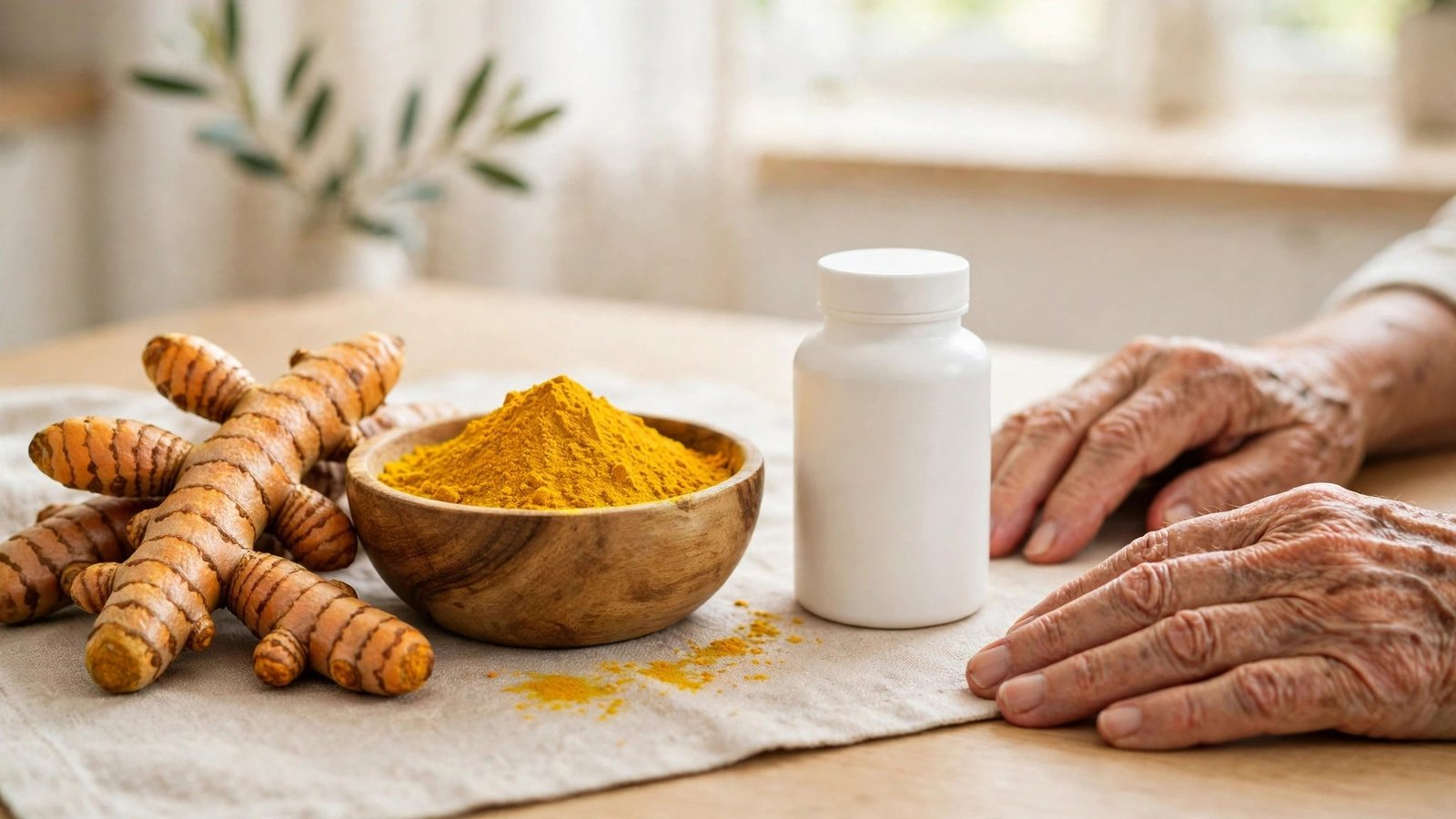
Turmeric is the golden-yellow spice made from the root (rhizome) of Curcuma longa, a plant in the ginger family grown in India and Southeast Asia. It has been used in cooking and in traditional medicine systems for thousands of years. Curcumin is the main active compound that gives turmeric its colour — and the ingredient most joint supplements are built around.
Two facts about curcumin explain most of the confusion on supplement labels:
- Curcumin is poorly absorbed on its own. When you swallow plain turmeric powder, very little curcumin reaches your bloodstream. That is why many products add piperine (an extract of black pepper) or use special formulations — liposomal, phytosome, nanoparticle, or “high-bioavailability” curcumin — to increase absorption.
- Turmeric spice and curcumin extract are not the same thing. A teaspoon of turmeric powder in food contains only a small amount of curcumin (roughly 3–5% curcuminoids by weight). A capsule labelled “500 mg turmeric” may contain far less curcumin than a capsule labelled “500 mg curcumin extract, standardised to 95% curcuminoids.” Always read which one the label states — this is the single most common labelling trap in this category.
The National Center for Complementary and Integrative Health (NCCIH) summarises the state of the science plainly: many studies have been conducted on turmeric or curcumin for osteoarthritis, but “we don’t know enough to definitively conclude if turmeric or curcumin is beneficial for any health purposes.”

What the Evidence Says About Turmeric for Knee Osteoarthritis
Knee osteoarthritis is where turmeric has been studied most. Several meta-analyses — studies that pool the results of many smaller trials — have looked at oral turmeric or curcumin for knee pain, stiffness, and mobility.
The initial evidence is positive: people taking curcumin reported less knee pain and stiffness and better joint function than people taking a placebo. But NCCIH cautions that higher-quality evidence is needed to reach firm conclusions, and more research is needed to understand how bioavailability affects results. The studies are hard to compare with each other because products differ widely — different curcumin amounts, different formulations, and many containing piperine or other plant substances.
What does that mean in practical terms for a senior?
- Turmeric is a reasonable “worth trying” option for knee osteoarthritis pain — with your doctor’s agreement — not a proven treatment.
- Expect modest effects, if any. In the trials, curcumin’s pain relief was roughly in the same range as some over-the-counter pain relievers, but results varied a lot between people. Some people notice a difference in 4–8 weeks; others notice nothing.
- It is not a painkiller. It will not work in an hour like ibuprofen or acetaminophen. If you try it, give it at least 6–8 weeks before judging — and keep a simple note of your pain and stiffness so you can judge honestly.
- Topical curcumin creams have very little evidence. NCCIH notes it is unclear whether topical curcumin ointment affects knee osteoarthritis pain.
How much curcumin do trials use?
There is no official recommended dose, because turmeric is sold as a dietary supplement, not a drug. Most knee-osteoarthritis trials used 500–1,500 mg of curcumin extract per day, usually split into two doses with food. Products labelled “turmeric root powder 500 mg” contain far less curcumin than “curcumin extract 500 mg.” Do not assume a higher number on the front of the bottle means a stronger product — check the Supplement Facts panel for the curcuminoid content.
The liver warning you must not skip
This is the most important safety point in this article. Conventionally formulated oral turmeric or curcumin is likely safe in recommended amounts for up to 2 or 3 months, according to NCCIH. But liver damage has been reported in some people who consumed highly bioavailable curcumin formulations — the very products marketed as “extra-strength” or “maximum absorption.” A 2023 case series from the US Drug-Induced Liver Injury Network documented ten cases of liver injury linked to turmeric supplements.
Stop taking turmeric or curcumin and contact your health care provider promptly if you notice symptoms of liver trouble: unusual fatigue, nausea, poor appetite, dark urine, or yellowing of the skin or eyes (jaundice). This risk is a real reason to prefer a standard formulation, to avoid megadoses, and to tell your doctor you are taking it — especially if you already have liver disease or take medicines processed by the liver.
Other common side effects of oral turmeric are milder but real: nausea, vomiting, acid reflux, stomach upset, diarrhoea, or constipation. Topical curcumin can cause hives or itching.
Glucosamine and Chondroitin: Why the Experts Disagree
Glucosamine and chondroitin are the two most widely sold joint supplements in the United States — often sold together in one capsule. Glucosamine is a compound found naturally in cartilage; chondroitin is a component of cartilage and connective tissue. The theory is that supplying more of these building blocks might slow cartilage breakdown or ease pain.
The evidence is genuinely mixed, and — unusually — the major guidelines flatly disagree with each other:
- A 2018 combined analysis of 29 studies in people with knee osteoarthritis (6,120 participants) found that global pain was significantly reduced by glucosamine or chondroitin taken separately, but not by the combination. Individual studies were inconsistent — some showed significant benefits, others did not.
- A 2014 analysis of 25 glucosamine studies (3,458 participants) found that the prescription drug formulation of glucosamine (crystalline glucosamine sulfate, sold as a medicine in Europe) generally had more favourable results than other forms — but most of those studies were old, had a high risk of bias, and were funded by the manufacturer.
- The American College of Rheumatology and the Arthritis Foundation (2019) strongly recommend against glucosamine alone or combined with chondroitin for knee osteoarthritis, stating that the best data do not show important benefits. The Osteoarthritis Research Society International (2019) reached the same conclusion.
- The American Academy of Orthopaedic Surgeons (2021), by contrast, includes glucosamine in a list of dietary supplements that may be helpful in reducing pain and improving function in mild-to-moderate knee osteoarthritis — while cautioning that the evidence is inconsistent.
- Chondroitin alone showed a significant benefit in a 2019 analysis of 18 studies (3,791 participants), but again with much inconsistency. When only low-bias studies were included, a specific pharmaceutical-grade preparation showed a greater reduction in pain — suggesting that product quality and formulation matter a great deal.
Bottom line for seniors: glucosamine and chondroitin are not proven, and the strongest US rheumatology guideline recommends against them. If you and your doctor decide to try them anyway, use a product from a reputable, third-party-tested brand, give it 2–3 months (these are slow-acting), and stop if you feel no difference. Do not keep paying for a supplement that is not helping you.
One practical note: glucosamine is usually made from shellfish shells. If you have a shellfish allergy, choose a vegetarian (corn-derived) glucosamine or avoid it — and check the label.
Collagen Peptides: Popular, But the Evidence Is Early
Collagen is the main protein in cartilage, tendons, and skin, and collagen peptide powders have become one of the fastest-selling joint products for people over 50. The idea is appealing: supply the raw material and the body will use it to maintain cartilage.
The honest summary: the evidence is early and thin. A small number of short trials — typically 3–6 months, with a few dozen to a few hundred participants — have reported modest improvements in knee pain and function with 5–10 grams of collagen peptides daily. But the trials are small, often funded by collagen manufacturers, and there are no large, long-term studies in seniors with osteoarthritis. No major US guideline recommends collagen for osteoarthritis.
Collagen peptides are generally well tolerated, with the main side effects being mild stomach upset or a bad taste. A few cautions still apply:
- Collagen powders are food products, not medicines — protein content, sourcing (bovine, marine, or porcine), and contamination testing vary by brand.
- If you have kidney disease, check with your doctor before adding a daily protein supplement — extra protein is not free of consequences when kidneys are impaired.
- Collagen is not a complete protein and does not replace dietary protein from food.
Collagen may be a reasonable low-risk experiment for some seniors, but it should not be your first or only step — and it is not a substitute for strength exercise, which is the one intervention that reliably supports the muscles protecting your joints.
Other Joint Supplements Seniors Ask About
Beyond the big three, several other products appear on joint-health shelves. Here is a quick, honest verdict on each:
Omega-3 fish oil. Omega-3 fatty acids have anti-inflammatory effects, and there is modest evidence that they can ease joint pain — the evidence is stronger for rheumatoid arthritis (an inflammatory arthritis) than for osteoarthritis. Fish oil also supports heart health, which is why many seniors already take it. The key warning: omega-3s can increase bleeding risk, especially combined with blood thinners. If you take warfarin, apixaban, clopidogrel, or daily aspirin, tell your doctor before adding fish oil.
MSM (methylsulfonylmethane). A sulphur compound sold for joint pain. A few small trials suggest modest pain relief, but the evidence is weak and short-term. Generally well tolerated; stomach upset is the main complaint.
SAMe (S-adenosylmethionine). Some small trials found SAMe relieved osteoarthritis pain about as well as some NSAIDs, but the studies were small and short. SAMe can interact with antidepressants and should not be combined with them without a doctor’s advice. It is also one of the more expensive options.
Boswellia (Indian frankincense). An Ayurvedic resin with a handful of small trials suggesting reduced knee pain and improved function. Evidence is preliminary; quality varies widely between products.
Vitamin D. Important for bone and muscle health — and many older adults are low in it — but vitamin D is not a joint-pain treatment. If your blood level is low, correcting it supports your bones and muscles, which helps your joints indirectly. Ask your doctor for a blood test rather than guessing.
Magnesium. Helps muscles relax and supports normal muscle function, which matters when stiff, painful joints make you move less. It is not a direct joint-pain remedy. Too much magnesium from supplements can cause diarrhoea and is risky if you have kidney disease.
Hyaluronic acid (oral). Marketed for joint lubrication. The evidence for oral hyaluronic acid is very limited; the injectable form given into the knee by a doctor is a different matter entirely.

Joint Supplements at a Glance
| Supplement | Evidence for knee osteoarthritis | Typical trial dose | Key safety watch-outs | Verdict for seniors |
|---|---|---|---|---|
| Turmeric / curcumin | Most promising; initial meta-analyses positive, higher-quality evidence still needed | 500–1,500 mg curcumin extract/day, split doses | Liver injury reported with high-bioavailability formulas; blood-thinner and diabetes-medicine interactions; stomach upset | Worth trying with doctor’s OK; prefer standard formulations |
| Glucosamine | Mixed; US rheumatology guideline recommends against; orthopaedic guideline lists as possibly helpful | 1,500 mg/day | Shellfish allergy; possible blood-thinner interaction; slow to judge (2–3 months) | Optional experiment; stop if no benefit |
| Chondroitin | Mixed; modest benefit in some analyses; guideline recommendations against | 800–1,200 mg/day | Possible blood-thinner interaction; product quality varies greatly | Optional experiment; prefer pharmaceutical-grade if trying |
| Collagen peptides | Early, small trials; modest pain/function gains reported | 5–10 g/day | Kidney disease caution (extra protein); brand quality varies | Low-risk experiment; not a first step |
| Omega-3 fish oil | Modest; stronger evidence in rheumatoid arthritis than osteoarthritis | 1–3 g combined EPA/DHA/day | Bleeding risk with blood thinners; fish allergy; burps/aftertaste | Reasonable if already taking for heart health; check with doctor |
| MSM | Weak, small trials only | 1,500–3,000 mg/day | Stomach upset; limited long-term data | Low priority |
| SAMe | Small trials, similar to some NSAIDs for pain | 600–1,200 mg/day | Interacts with antidepressants; expensive | Discuss with doctor first, especially on mood medicines |
| Boswellia | Preliminary, small trials | 300–500 mg/day | Limited safety data in seniors; product quality varies | Low priority; early evidence only |
Doses shown are those commonly used in clinical trials, not official recommendations. There is no FDA-approved dose for any of these supplements.
Interactions and Safety: The Section That Matters Most
Joint supplements are often sold as “natural,” and natural is easily mistaken for safe. After 60, most people take at least one prescription medicine, and that is where the real risk lies. Always show your doctor or pharmacist the actual bottle — not just the product name — before you start.
Blood thinners (warfarin, apixaban, rivaroxaban, clopidogrel, daily aspirin). Turmeric, curcumin, glucosamine, chondroitin, omega-3 fish oil, and MSM may all increase bleeding risk or interfere with how blood thinners work. This is the single most important interaction in this article. If you take any blood thinner, do not start a joint supplement without your doctor’s explicit agreement — and never stop your blood thinner to take a supplement.
Diabetes medicines. Turmeric and curcumin may lower blood sugar. Combined with diabetes medicines or insulin, blood sugar can drop too low. If you have diabetes, monitor your blood sugar more closely when starting turmeric and tell your doctor.
Blood pressure medicines. Curcumin may have mild blood-pressure effects. It is not a substitute for your prescribed medicine, and any change in your readings should be reported to your doctor.
Liver disease or medicines processed by the liver. Highly bioavailable curcumin products have been linked to liver injury. If you have liver disease, drink alcohol regularly, or take medicines that affect the liver, be especially cautious — and tell your doctor you are taking turmeric.
Surgery. Many surgeons ask patients to stop herbal and dietary supplements 1–2 weeks before an operation because of bleeding risk. Tell your surgeon about every supplement you take, and follow their instructions.
Gallbladder disease and kidney stones. Turmeric can worsen gallbladder problems and contains oxalates, which may matter if you form kidney stones. Mention both conditions to your doctor.
Pregnancy and breastfeeding. Turmeric supplements in amounts above those found in food may be unsafe during pregnancy, and little is known about safety while breastfeeding. This article is for adults aged 40–80, but it is worth stating plainly for any younger reader sharing it with family.
Allergies. Glucosamine from shellfish, fish oil, and collagen from fish (marine collagen) can all trigger allergies. Read the source on the label, not just the front of the bottle.
The FDA does not approve supplements before they are sold. Under the law, the FDA regulates dietary supplements differently from drugs. Manufacturers are responsible for the safety and labelling of their own products, and the FDA can act only after a problem reaches the market. That is exactly why third-party testing matters — see the buying guide below.
10 Common Mistakes Seniors Make With Joint Supplements
- Expecting a cure. No supplement regrows cartilage or reverses osteoarthritis. If a product promises that, it is lying.
- Taking turmeric spice instead of curcumin extract — or vice versa. A teaspoon of cooking turmeric and a 500 mg curcumin-extract capsule are very different doses. Know which one you are taking.
- Choosing the strongest absorption formula without asking about the liver. High-bioavailability curcumin is the category with reported liver injuries. Stronger absorption is not automatically safer.
- Starting three supplements at once. If you start turmeric, glucosamine, and collagen on the same day and feel better — or worse — you will not know which one did it. Start one at a time, at least 4 weeks apart.
- Not telling your doctor. Surveys consistently show that many older adults do not mention supplements to their doctors. Bring the bottles to your appointment.
- Stopping prescribed medicine to take a supplement. A supplement never replaces a prescribed drug. If pain medicine worries you, discuss alternatives with your doctor — do not quietly swap it out.
- Judging too quickly — or never judging at all. Most joint supplements need 6–12 weeks to show anything. But the opposite mistake is also common: taking the same bottle for two years without ever checking whether it helps. Set a review date.
- Buying on price alone. The cheapest bottle is often the one with the least curcumin, the weakest testing, or fillers. Price is not proof of quality — but suspiciously cheap usually is a warning.
- Ignoring the Supplement Facts panel. The front label is marketing. The panel on the back tells you the actual ingredient, amount, and serving size.
- Skipping the foundations. A supplement cannot compensate for no movement, excess weight, weak leg muscles, or poor sleep. Exercise, weight management, and strength training do more for your joints than any capsule.
How to Buy Joint Supplements Safely
Because the FDA does not test supplements before sale, quality control is largely up to you. Use this checklist before you buy:
- Look for third-party testing seals. USP Verified, NSF Certified for Sport (or NSF Contents Certified), or ConsumerLab approval mean an independent lab checked that the product contains what the label claims and is free of common contaminants. A seal is not a guarantee of effectiveness — but its absence is a reason to be cautious.
- Read the Supplement Facts panel. Check the exact ingredient (curcumin extract vs turmeric root powder), the amount per serving, and the number of servings. “Proprietary blend” without amounts tells you nothing.
- Check standardisation. For curcumin, look for “standardised to 95% curcuminoids.” For glucosamine, note whether it is glucosamine sulfate or glucosamine hydrochloride — the prescription-grade trials used crystalline glucosamine sulfate.
- Avoid absurd claims. “Rebuilds cartilage,” “cures arthritis,” “doctor-recommended miracle,” or “results in 7 days” are red flags. Legitimate products use cautious language.
- Buy from established sellers. Counterfeit supplements are a real problem on large marketplaces. Prefer the manufacturer’s own store or a reputable pharmacy.
- Check expiry dates and storage. Store supplements in a cool, dry place, away from the bathroom cabinet’s humidity, and discard expired bottles.
- Compare cost per day, not cost per bottle. A $40 bottle with 30 servings costs more per day than a $50 bottle with 90 servings. Work out the daily cost of the dose you would actually take.
- Keep a list. Write down every supplement, dose, and start date, and keep it with your medicine list. Bring it to every appointment and to the pharmacy.

A Sensible 4-Week Plan (With Your Doctor’s Agreement)
Supplements work best as part of a plan, not as a hope in a bottle. Here is a practical starting point to discuss with your doctor:
| Week | Focus |
|---|---|
| Week 1 | Talk to your doctor or pharmacist. Bring your medicine list and the supplement you are considering. Get your vitamin D level checked if it has not been done recently. Start a simple pain-and-stiffness diary (1–10 scale, morning and evening). |
| Week 2 | If approved, start ONE supplement only — for most seniors, a standard curcumin extract is the best-evidenced first try. Take it with food, as directed. Begin or continue gentle daily movement: walking, and the strength exercises your doctor or physical therapist recommends. |
| Week 3 | Keep the diary going. Note sleep, stomach upset, bruising, or any unusual symptoms. Do not add a second supplement yet. Check your blood pressure and blood sugar as usual if you monitor them. |
| Week 4 | Review the diary with your doctor or pharmacist. Any side effects? Any change in pain or stiffness? If there is no change at all, remember that most trials ran 8–12 weeks — but also set a firm review date (week 8–12) after which you will stop if there is still no benefit. |
And alongside any supplement: keep moving. The NIA and CDC both emphasise that regular physical activity — including strength and balance exercise — is one of the most effective ways to protect mobility as you age. If pain limits you, ask your doctor for a referral to a physical therapist, who can design a programme around your joints rather than against them.
When to See a Doctor Promptly
Supplements are for slow, everyday joint aches — not for new or alarming symptoms. See your doctor promptly, or seek urgent care where noted, if you notice:
- A joint that is suddenly hot, red, and very swollen, especially with fever — this can be infection, which needs urgent treatment.
- Joint pain after a fall or injury, or a joint that cannot bear weight.
- Pain that wakes you at night, or pain that is rapidly getting worse over days.
- Numbness, tingling, or weakness in the arm or leg near a painful joint.
- Unexplained weight loss, fever, or a rash along with joint pain.
- Any sign of bleeding while taking a supplement with a blood thinner — unusual bruising, nosebleeds, blood in urine or stool, or a cut that will not stop bleeding (seek urgent care).
- Symptoms of liver trouble after starting turmeric or curcumin: unusual fatigue, nausea, poor appetite, dark urine, or yellowing of the skin or eyes (stop the supplement and contact your doctor promptly).
Frequently Asked Questions
Is turmeric safe for seniors?
Turmeric as a food spice is safe for most people. Turmeric or curcumin supplements are likely safe in recommended amounts for up to 2–3 months when using conventional formulations, according to NCCIH. The main cautions are for people on blood thinners or diabetes medicines, people with liver or gallbladder disease, and people considering high-bioavailability formulas, which have been linked to liver injury. Always check with your doctor first.
Does turmeric really help knee pain?
The early evidence is encouraging: several meta-analyses found that curcumin reduced knee osteoarthritis pain and stiffness and improved function. But the studies vary widely in product and dose, and NCCIH says higher-quality evidence is still needed. Think of it as “promising, not proven” — worth a careful try with your doctor’s agreement, not a guaranteed fix.
How much curcumin should a senior take per day?
There is no official recommended dose. Most knee-osteoarthritis trials used 500–1,500 mg of curcumin extract per day, usually in two doses with food. Do not exceed the label dose, and prefer a standardised extract from a third-party-tested brand. Your doctor can advise on a dose that fits your medicines and health conditions.
Can I take turmeric with a blood thinner?
Do not start turmeric or curcumin without your doctor’s explicit agreement if you take warfarin, apixaban, rivaroxaban, clopidogrel, or daily aspirin. Turmeric may increase bleeding risk and can interfere with how these medicines work. The same caution applies to glucosamine, chondroitin, and fish oil.
Which is better for joint pain — turmeric or glucosamine?
Turmeric (curcumin) currently has the more encouraging evidence base for knee osteoarthritis pain, with positive meta-analyses. Glucosamine’s evidence is more mixed, and the American College of Rheumatology recommends against it. But neither is proven, and individual responses vary. Some people try one, judge it over 8–12 weeks, and then — with their doctor’s agreement — try the other. Do not start both at once.
How long does it take for joint supplements to work?
Most trials ran 8–12 weeks. Give any single supplement at least 6–8 weeks before judging, keep a simple pain diary, and set a review date. If there is no benefit after 12 weeks, stop taking it — there is no reason to keep paying for something that is not helping you.
Are collagen supplements good for joints after 60?
The evidence is early: small, short trials suggest modest improvements in knee pain and function with 5–10 grams of collagen peptides daily, but there are no large long-term studies in seniors, and no major guideline recommends collagen for osteoarthritis. Collagen is generally well tolerated, but check with your doctor first if you have kidney disease.
What should I look for on a joint supplement label?
Check the Supplement Facts panel for the exact ingredient and amount (for example, “curcumin extract, standardised to 95% curcuminoids”), look for a third-party testing seal (USP Verified or NSF), avoid products that promise to cure arthritis or rebuild cartilage, and buy from a reputable seller. Bring the bottle to your doctor or pharmacist and ask them to check it against your medicines.
Conclusion
Turmeric and joint supplements are among the most-searched health topics for adults over 60 — and the market is full of confident promises that the science does not support. Here is the balanced summary to carry with you:
- Turmeric/curcumin has the most promising evidence for knee osteoarthritis pain, but it is not proven, and high-bioavailability formulas carry a real liver-injury warning.
- Glucosamine and chondroitin have mixed evidence, and major US guidelines disagree — the rheumatology guideline recommends against them.
- Collagen, MSM, SAMe, and Boswellia have only early or small-scale evidence.
- No supplement cures arthritis or regrows cartilage. Movement, strength, weight management, and your doctor’s plan remain the foundation.
- Interactions matter more than benefits for most seniors — especially with blood thinners, diabetes medicines, and liver conditions. Tell your doctor about every supplement, bring the bottle, and start one product at a time.
If you decide to try a joint supplement, do it the careful way: choose a third-party-tested product, take the trial dose for 8–12 weeks, keep a simple pain diary, and review the result with your doctor. That is how you find out whether a supplement is genuinely helping you — instead of just helping the company that sold it.
Next step: Make a list of every supplement and medicine you currently take, and bring it — bottles included — to your next doctor or pharmacist visit. Ask specifically: “Is turmeric safe with my medicines?” It is a five-minute conversation that can prevent a serious problem. And if stiff, painful joints are limiting your daily life, ask about a physical therapy referral — stronger muscles around a joint are the most reliable “joint supplement” there is.
This article is general information, not medical advice. Talk to your doctor or pharmacist before starting, stopping, or changing any supplement or medicine.
Sources
- National Center for Complementary and Integrative Health (NCCIH) — Turmeric: Usefulness and Safety (updated April 2025) — https://www.nccih.nih.gov/health/turmeric
- National Center for Complementary and Integrative Health (NCCIH) — Glucosamine and Chondroitin for Osteoarthritis — https://www.nccih.nih.gov/health/glucosamine-and-chondroitin-for-osteoarthritis
- National Institute of Arthritis and Musculoskeletal and Skin Diseases (NIAMS) — Osteoarthritis: Symptoms, Causes and Risk Factors — https://www.niams.nih.gov/health-topics/osteoarthritis
- MedlinePlus (U.S. National Library of Medicine) — Osteoarthritis — https://medlineplus.gov/osteoarthritis.html
- U.S. Food and Drug Administration (FDA) — Dietary Supplements — https://www.fda.gov/food/dietary-supplements