Eye Health After 60: Cataracts, Annual Eye Exams and Warning Signs Not to Ignore
Your eyes have carried you through six decades of reading, driving, working and watching grandchildren grow. After 60, they deserve a little more attention — because most of the eye diseases that threaten sight in later life are silent at first, and the ones that are caught early are the ones that can be treated….
Your eyes have carried you through six decades of reading, driving, working and watching grandchildren grow. After 60, they deserve a little more attention — because most of the eye diseases that threaten sight in later life are silent at first, and the ones that are caught early are the ones that can be treated. Eye health after 60 comes down to three things: know the conditions that become common at this age, get a comprehensive dilated eye exam every year, and act the same day on any sudden change in your vision. Cataracts, macular degeneration, glaucoma and diabetic retinopathy rarely announce themselves with pain. An annual exam is how they get found while treatment still works.
That is the short answer. The rest of this guide explains what changes in your eyes after 60, what each major condition feels like, exactly what happens at an eye exam (including the dilation drops), which warning signs mean “call today” and which mean “go now”, what Medicare does and does not pay for, and the everyday habits that genuinely help.
How Your Eyes Change After 60 — What’s Normal and What Isn’t
Some change is a normal part of aging, and it helps to know which changes are expected so you can spot the ones that are not.
Presbyopia — trouble seeing up close. Around age 40 the lens inside your eye gradually stiffens, and by 60 most people need reading glasses or bifocals. Holding the newspaper at arm’s length is normal; it is corrected with glasses, not a sign of disease.
Needing more light. The pupil gets smaller with age and the lens lets in less light, so you may need brighter lamps to read comfortably. The National Institute on Aging notes that needing more time to adjust when light levels change is also common.
Colours look less vivid. Distinguishing blue from black can get harder, and colours may look slightly faded. This is usually a gradual, harmless change — but a sudden change in how colours look deserves a check.
Drier eyes. Tear glands work less well with age, and dry eye is especially common in women after 60. Burning, stinging or a gritty feeling can often be eased with artificial tears, but persistent dryness should be mentioned at your exam.
Floaters. Tiny specks or cobwebs drifting across your vision are common as the jelly inside the eye changes with age. A few floaters that have been there for years are usually harmless. A sudden shower of many new floaters, especially with flashes of light, is different — see the warning-signs section below and treat it as urgent.
What is not normal aging: vision that keeps getting worse despite new glasses, a blind spot, straight lines that look wavy, loss of side vision, or any sudden change. Those are signs of disease, not age, and they need an eye doctor — not a stronger pair of reading glasses from the drugstore.
Cataracts After 60: The Most Common — and Most Treatable — Cause of Blurry Vision

A cataract is a cloudy area in the lens of your eye — the clear part that helps focus light. Cataracts are very common as you get older. The National Eye Institute (NEI) reports that more than half of all Americans age 80 or older either have cataracts or have had surgery to remove them.
What cataracts feel like
At first you may notice nothing at all. As the cataract grows, you may find that:
- Your vision is cloudy or blurry, as if you are looking through a foggy window
- Colours look faded or yellowed
- You cannot see well at night, and driving after dark gets harder
- Lamps, sunlight or oncoming headlights seem too bright, or you see halos around lights
- You see double in one eye
- You need a new glasses prescription more often than usual
If several of these sound familiar, it is worth booking an eye exam — but it is not a reason to panic. Cataracts develop slowly, and early cataracts often need no treatment at all.
What raises your risk
Your risk rises with age, and it is higher if you have diabetes, smoke, drink heavily, have a family history of cataracts, have had an eye injury or eye surgery, have spent a lot of time in the sun without eye protection, or take steroid medicines for conditions such as arthritis or allergies.
How cataracts are treated
Surgery is the only way to remove a cataract, but you may not need it right away. Early on, brighter lights at home, anti-glare sunglasses and magnifying lenses for reading can help. A new glasses prescription can also help for a while.
Your doctor may suggest surgery when cataracts start getting in the way of everyday activities such as reading, driving or watching television. During cataract surgery the doctor removes the clouded lens and replaces it with a clear artificial lens (called an intraocular lens, or IOL). The NEI notes that the surgery is very safe, and 9 out of 10 people who have it can see better afterwards. Most people do not need to rush: waiting usually will not harm your eyes or make surgery more difficult later. Talk through the timing, the lens options and the costs with your eye doctor — and note that Medicare Part B generally covers cataract surgery when it is medically necessary, including one pair of glasses or contact lenses afterwards.
Can you prevent cataracts?
You cannot prevent them entirely, but you can lower your risk: wear sunglasses that block UV light and a wide-brimmed hat outdoors, protect your eyes during DIY or sports, quit smoking, and eat plenty of fruits, vegetables, leafy greens, nuts and whole grains.
Age-Related Macular Degeneration (AMD): When Straight Lines Start to Look Wavy
AMD is an eye disease that blurs your central vision — the sharp, straight-ahead vision you use to read, recognise faces and drive. It happens when aging damages the macula, the part of the retina that controls central vision. It is a leading cause of vision loss for older adults in the United States. About 11 million people in the US have AMD, according to the NEI.
AMD does not cause complete blindness — your side (peripheral) vision usually stays — but losing central vision makes everyday tasks much harder.
Dry AMD and wet AMD
Most people with AMD have dry AMD, where the macula thins with age. It moves through three stages — early, intermediate and late — and usually progresses slowly over several years. Early dry AMD has no symptoms at all, which is why regular eye exams matter so much: the disease can be present for years before you notice anything.
Wet AMD is a less common type of late AMD that usually causes faster vision loss. It happens when abnormal blood vessels grow in the back of the eye and damage the macula. Any stage of dry AMD can turn into wet AMD.
Symptoms to know
- Early dry AMD: no symptoms
- Intermediate dry AMD: mild blurriness in central vision, or trouble seeing in low light — or still no symptoms
- Late AMD (wet or dry): straight lines start to look wavy or crooked, a blurry or blank area appears near the centre of your vision, colours seem less bright, and low-light vision gets worse
Straight lines looking wavy is a warning sign for late AMD. If you notice it, see your eye doctor right away.
Treatment
There is currently no treatment for early AMD — your doctor will simply monitor your eyes with regular exams. If you have intermediate AMD in one or both eyes, special dietary supplements (the AREDS2 formula of vitamins and minerals) may help stop it turning into late AMD. Your doctor can advise whether they are right for you — do not start them on your own, because high-dose supplements can interact with medicines and are not suitable for everyone, including some smokers.
Wet AMD can be treated with medicines called anti-VEGF drugs, injected into the eye, and sometimes with photodynamic therapy (a combination of injections and laser treatment). These treatments aim to stop further vision loss. There is no treatment yet for late dry AMD, but low-vision devices and vision rehabilitation services can help you make the most of the vision you have.
Lowering your risk
Research shows you may be able to lower your risk of AMD — or slow vision loss from it — by quitting smoking, getting regular physical activity, keeping your blood pressure and cholesterol in a healthy range, and eating healthy foods including leafy green vegetables and fish.
A simple at-home check: the Amsler grid is a printed grid of straight lines you look at one eye at a time. If lines look wavy, bent or missing, call your eye doctor. It is a screening aid, not a diagnosis — it never replaces a dilated exam.
Glaucoma: The Silent Thief of Sight
Glaucoma is a group of eye diseases that can cause vision loss and blindness by damaging the optic nerve, the nerve at the back of your eye. The NEI calls it a silent disease for a reason: at first, glaucoma usually has no symptoms at all. In fact, about half of people with glaucoma do not even know they have it.
Why it is so dangerous
Open-angle glaucoma — the most common type in the United States — damages your side (peripheral) vision so slowly that you may not notice it until a large amount of vision is already gone. By the time you realise you cannot see things off to the side, the damage is permanent. Treatment cannot bring back lost vision, but it can usually stop the damage from getting worse. That is why the exam matters more than symptoms: the only way to find out if you have glaucoma is a comprehensive dilated eye exam.
Who is at higher risk
Anyone can get glaucoma, but your risk is higher if you are over 60 (especially if you are Hispanic or Latino), are African American and over 40, or have a family history of glaucoma. If you are at higher risk, talk with your doctor about getting a comprehensive dilated eye exam every 1 to 2 years.
How it is treated
Doctors treat glaucoma with prescription eye drops (the most common treatment), laser treatment, or surgery. The drops lower the pressure in your eye and protect the optic nerve. If your doctor prescribes drops, use them every day, exactly as directed — missing doses lets pressure rise again. Tell your doctor about side effects rather than stopping on your own, and keep every follow-up appointment, because pressure can only be checked in the office.
A glaucoma emergency — act now
One less common type, angle-closure glaucoma, can come on suddenly with intense eye pain, nausea, a red eye and blurry vision. If you have these symptoms, go to your doctor or an emergency room immediately. It is a genuine emergency.
Diabetic Retinopathy: Why Diabetes Makes Eye Exams Non-Negotiable
If you have diabetes, your eye risk is higher — and your exam schedule is stricter. Diabetic retinopathy develops slowly and often has no early warning signs. High blood sugar damages the tiny blood vessels in the retina over time. The National Institute on Aging advises that people with diabetes should have a dilated eye exam at least once a year.
Keeping your blood sugar, blood pressure and cholesterol under control can prevent diabetic retinopathy or slow it in its early stages. In later stages, laser surgery can sometimes prevent it from getting worse. If you have diabetes and have never had a dilated eye exam, book one this week — not next year. The same goes for high blood pressure, which can also damage the blood vessels in your eyes.
Dry Eye, Presbyopia and Other Common Problems After 60
Not every eye problem after 60 threatens your sight. Some are uncomfortable or inconvenient, and most can be managed:
- Dry eye: stinging, burning, a sandy feeling, or eyes that water too much (the eye over-produces tears to compensate for dryness). Artificial tears, a humidifier at home, and avoiding smoke and wind often help. For more severe cases, your doctor may suggest prescription drops, tear-duct plugs or other treatments.
- Presbyopia: the need for reading glasses, as above. It is universal, not a disease.
- Floaters and flashes: a few floaters are common with age. A sudden burst of new floaters, flashes of light, or a dark shadow or “curtain” across your vision can signal a retinal tear or detachment — seek care the same day.
- Eye strain from screens: the 20-20-20 rule helps — every 20 minutes, look at something about 20 feet away for 20 seconds. It will not prevent disease, but it eases tired, dry eyes after long reading or computer sessions.
The Annual Eye Exam After 60: What Actually Happens

Many people put off eye exams because they are unsure what is involved, or because they can still see well enough to get by. Here is what a comprehensive dilated eye exam actually includes, so there are no surprises.
Before the exam
Make a list of your questions and concerns, and bring a list of all the medicines and supplements you take — some can affect your eyes. Bring your current glasses or contact lenses, and your sunglasses for the drive home.
During the exam
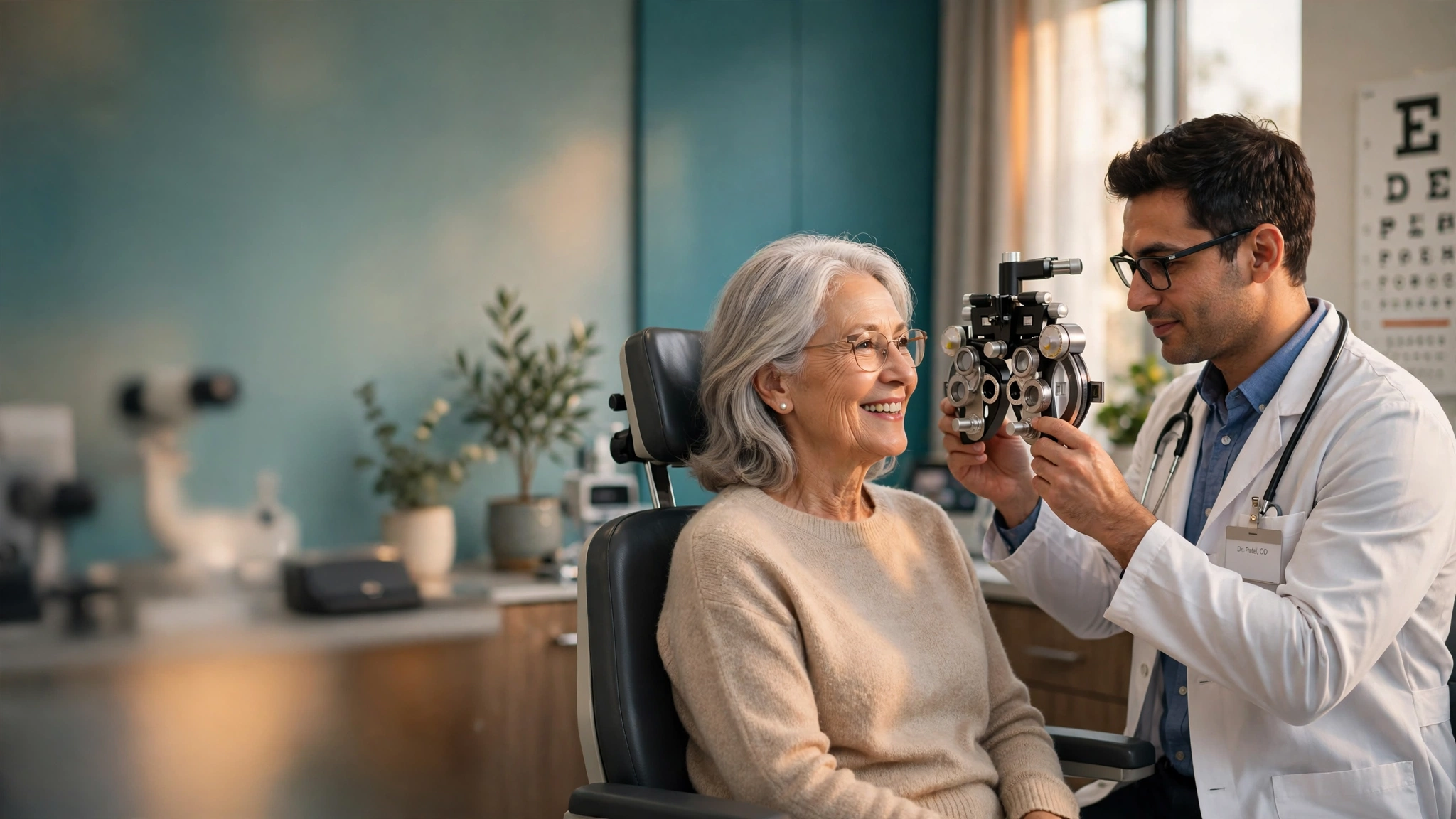
A comprehensive adult eye and vision examination, as described by the American Optometric Association, typically includes:
- Patient history — your eye and vision symptoms, when they began, your medicines, your work and environment, and your family’s eye and general health history.
- Visual acuity — reading letters on a chart at distance and up close. Results are written as a fraction such as 20/40: you would need to stand 20 feet away to read a letter that should be clear at 40 feet. Normal distance vision is 20/20.
- Preliminary tests — depth perception, colour vision, eye muscle movements, side (peripheral) vision, and how your pupils respond to light.
- Refraction — the “which is better, one or two?” test with the phoropter, which finds the lens power you need for glasses or contacts.
- Eye focusing, teaming and movement tests — how well your eyes focus, move and work together.
- Eye health evaluation — the doctor examines the structures of your eye with microscopes, lenses and digital technology, and measures the pressure inside your eye. Dilating drops are often used to widen the pupil so the doctor can see the retina and optic nerve clearly.
The exam is simple and painless. The dilation drops may sting briefly, and afterwards your vision will be blurry and your eyes sensitive to light for a few hours. Arrange for someone else to drive you home — do not plan to drive yourself after a dilated exam.
How often should you go?
| Age / situation | Recommended exam frequency |
|---|---|
| 60–64, no symptoms, low risk | At least every 2 years (many doctors advise yearly) |
| 65 and older | At least once a year (AOA recommendation) |
| Diabetes or high blood pressure | At least once a year, dilated |
| Family history of glaucoma, AMD or other eye disease | Every 1–2 years, or as your doctor advises |
| You already have an eye condition | As often as your eye doctor recommends |
| Any new symptom | Book promptly — do not wait for your annual exam |
The National Institute on Aging puts it plainly: everyone over 50 should have a dilated eye exam every year or as recommended, and after 60, every year or two. If you have diabetes or high blood pressure, at least once a year. A vision screening — at the DMV, a health fair, or your GP’s office — is not a substitute: screenings usually test only distance vision and can miss most eye diseases. Only a comprehensive exam by an optometrist or ophthalmologist can confirm or rule out eye disease.
Optometrist or ophthalmologist — who do you need?
An optometrist (OD) provides primary eye care: exams, glasses and contact lens prescriptions, and detection of eye disease. An ophthalmologist (MD) is a medical doctor who can also diagnose and treat eye disease, prescribe medicines, and perform surgery such as cataract operations. For a routine annual exam, either is appropriate; if disease is found, you will be referred to the right specialist.
Warning Signs After 60: Call Today, or Go Now
Some symptoms can wait for an appointment this week. Others cannot wait at all. Learn the difference — it can save your sight.
Call your eye doctor today (same-day appointment)
- Straight lines look wavy, bent or distorted
- A new blurry or blank spot near the centre of your vision
- Vision that suddenly gets worse in one eye
- Colours suddenly look washed out or different in one eye
- Many new floaters, especially with flashes of light
- Double vision that does not go away
- Eye pain, redness or swelling that does not settle
Go to urgent care or the emergency room now
- Sudden loss of vision in one or both eyes, or everything suddenly blurry
- A dark shadow or curtain spreading across your vision
- Intense eye pain with nausea, red eye and blurry vision (possible angle-closure glaucoma)
- An eye injury, chemical splash, or a foreign object in the eye
- Sudden double vision with a severe headache
Do not wait to see whether it gets better on its own. For retinal detachment and angle-closure glaucoma, hours matter.
What Does Medicare Cover for Eye Care?
This is one of the most common questions after 60, and the answer surprises many people: Original Medicare (Part A and Part B) does not cover routine eye exams for glasses or contact lenses. It also does not cover glasses or contact lenses in general. There are important exceptions:
- Cataract surgery is covered when medically necessary, including one pair of glasses or contact lenses afterwards.
- Glaucoma screenings are covered once a year for people at high risk (including people with diabetes, a family history of glaucoma, African Americans age 50+, and Hispanic Americans age 65+).
- Diabetic eye exams for diabetic retinopathy are covered for people with diabetes.
- Macular degeneration treatment (such as anti-VEGF injections) is covered when medically necessary.
- Eye exams related to a medical problem — for example, an eye injury or a disease — may be covered as a medical service.
Medicare Advantage (Part C) plans often add routine vision benefits, including annual eye exams and an allowance for glasses — check your own plan’s details. For the full picture of what Original Medicare leaves out, see our guide to What Original Medicare Does Not Cover: Dental, Vision, Hearing and Long-Term Care Options
Everyday Habits That Protect Your Eyes After 60

No habit can guarantee you will never develop an eye disease, and no food or supplement replaces an exam. But these habits are supported by the National Eye Institute and the National Institute on Aging, and they genuinely help:
- Get your eyes checked regularly. This is the single most effective step. Put the next exam on the calendar before you leave the office.
- Protect your eyes from sunlight. Wear sunglasses that block UV radiation and a hat with a wide brim outdoors — UV exposure is linked to cataracts.
- Stop smoking. Smoking raises your risk of cataracts and AMD. If you are ready to quit, call 1-800-QUIT-NOW (1-800-784-8669) for free support in the US.
- Make eye-healthy food choices. Leafy green vegetables, oily fish such as salmon, citrus fruit, nuts and whole grains are good choices. If you want more detail on fish and omega-3s, see our guide to Omega-3 for Heart Health Over 60: Fish Oil, Food Sources, Dose and Blood-Thinner Warnings
- Be physically active and maintain a healthy weight. Activity supports healthy blood pressure and blood sugar, which protects the small blood vessels in your eyes. A gentle place to start is our Strength Training for Seniors: A Safe Beginner Guide for Ages 60–80
- Manage blood pressure and diabetes. Both damage the retina over time. If you monitor blood pressure at home, our step-by-step guide explains How to Check Your Blood Pressure at Home Correctly
- Use the right glasses. Keep your prescription up to date — even small changes in sight can raise your risk of falls. See our Fall Prevention for Seniors at Home: A Room-by-Room Safety Checklist — and Balance Problems After 50: Causes, Tests and Exercises That Reduce Fall Risk — for how vision and steadiness connect.
- Give your eyes breaks. Follow the 20-20-20 rule during long reading or screen sessions.
- Wear protective eyewear for DIY, gardening with power tools, and sports where something could hit your eye.
10 Common Mistakes People Over 60 Make About Their Eyes
- Skipping exams because “I can still see fine.” Glaucoma and early AMD have no symptoms. Good vision today does not mean healthy eyes.
- Treating a DMV or health-fair screening as an eye exam. Screenings miss most eye disease. They are a starting point, never a substitute.
- Buying stronger reading glasses instead of getting checked. New glasses can mask a worsening cataract or AMD.
- Waiting to see if a sudden symptom clears up. Sudden vision changes need same-day care.
- Stopping glaucoma drops when the eyes “feel fine.” The drops work silently; stopping lets pressure rise and damage resume.
- Starting high-dose eye supplements without asking a doctor. AREDS2 supplements help some people with intermediate AMD, but they are not for everyone and can interact with medicines.
- Driving after a dilated exam. Your vision will be blurry and light-sensitive for hours. Arrange a lift.
- Skipping sunglasses. UV exposure adds up over a lifetime and raises cataract risk.
- Assuming Medicare covers routine eye exams. It does not — budget for the exam and glasses, or check your Medicare Advantage plan.
- Ignoring the link between eyes and falls. Poor vision is a major fall risk. If your sight changes, review your home safety and balance at the same time.
Frequently Asked Questions
1. How often should I get an eye exam after 60?
The American Optometric Association recommends an eye exam at least once a year from age 65, and at least every two years from 40 to 64. The National Institute on Aging advises a dilated eye exam every year or two after 60, and at least once a year if you have diabetes or high blood pressure. If you have an eye condition or a family history of one, your doctor may want to see you more often.
2. What is the difference between an optometrist and an ophthalmologist?
An optometrist (OD) provides primary eye care, including exams and glasses or contact lens prescriptions, and detects eye disease. An ophthalmologist (MD) is a medical doctor who can also prescribe medicines and perform eye surgery. For a routine annual exam, either is fine; if a disease is found, you will be referred on.
3. Does Medicare pay for eye exams and glasses?
Original Medicare does not cover routine eye exams for glasses or contacts, or glasses themselves. It does cover cataract surgery when medically necessary (plus one pair of glasses or contacts afterwards), annual glaucoma screening for high-risk people, diabetic eye exams, and treatment for conditions such as macular degeneration. Many Medicare Advantage plans add routine vision benefits — check your plan.
4. Are cataracts a normal part of aging, and do they always need surgery?
Cataracts are very common with age — more than half of Americans 80 or older have them or have had surgery. They do not always need surgery: early cataracts can often be managed with brighter light, anti-glare sunglasses and a new glasses prescription. Surgery is suggested when cataracts interfere with everyday activities such as reading or driving. It is very safe, and 9 out of 10 people see better afterwards.
5. What are the first signs of macular degeneration?
Early AMD has no symptoms, which is why exams matter. Intermediate AMD may cause mild blurriness in central vision or trouble in low light. Late AMD causes straight lines to look wavy or crooked, a blurry or blank spot in the centre of your vision, and colours that look less bright. If straight lines look wavy, see your eye doctor right away.
6. Can glaucoma be cured?
There is no cure for glaucoma, but early treatment can often stop the damage and protect the vision you still have. Treatment usually means prescription eye drops used every day, sometimes laser treatment or surgery. Because glaucoma has no early symptoms, regular dilated eye exams are the only reliable way to catch it in time.
7. What should I do if I suddenly see many new floaters or flashes of light?
Contact your eye doctor the same day, or go to urgent care. A sudden shower of floaters with flashes of light can signal a retinal tear or detachment, which needs prompt treatment. A few long-standing floaters are usually harmless, but a sudden change is always worth an urgent call.
8. Are eye vitamins and supplements worth taking after 60?
For most people, a balanced diet rich in leafy greens, fish, fruit and nuts is the best foundation. Special AREDS2 supplements may help slow intermediate AMD, but only for some people — and high-dose supplements can interact with medicines. Ask your eye doctor or pharmacist before starting any supplement, and never take a supplement as a substitute for an eye exam.
Conclusion: Your Sight Is Worth One Appointment a Year
Eye health after 60 is not complicated, but it does need a routine. Know the four conditions that matter most — cataracts, macular degeneration, glaucoma and diabetic retinopathy. Get a comprehensive dilated eye exam every year, and bring someone to drive you home. Learn the warning signs that mean “call today” and the ones that mean “go now”. And protect your eyes in daily life with sunglasses, good food, activity and blood-sugar and blood-pressure control.
Most vision loss after 60 is not inevitable. The diseases that cause it are often silent — but they are also often treatable when they are found early. The exam that finds them takes about an hour, once a year. If you have not had one in the last 12 months, book it today — and while you are at it, put next year’s appointment on the calendar before you leave the office.
Next step: check when your last eye exam was. If it was more than a year ago, or you have noticed any of the warning signs in this guide, call your eye doctor this week. Your future self — still reading, driving and recognising the faces you love — will thank you.
Medical disclaimer
This article is general information only. It is not medical advice, and it does not replace the advice of your own doctor or eye care professional. Eye conditions vary from person to person, and only an examination can tell what is happening with your eyes. Talk to your doctor or eye care professional before starting, stopping or changing any medicine, supplement or treatment, and seek prompt care for any sudden change in your vision.
Sources
- National Eye Institute — Cataracts: https://www.nei.nih.gov/learn-about-eye-health/eye-conditions-and-diseases/cataracts
- National Eye Institute — Age-Related Macular Degeneration: https://www.nei.nih.gov/learn-about-eye-health/eye-conditions-and-diseases/age-related-macular-degeneration
- National Eye Institute — Glaucoma: https://www.nei.nih.gov/learn-about-eye-health/eye-conditions-and-diseases/glaucoma
- National Institute on Aging — Aging and Your Eyes: https://www.nia.nih.gov/health/aging-and-your-eyes
- American Optometric Association — Comprehensive Eye Exams: https://www.aoa.org/healthy-eyes/caring-for-your-eyes/eye-exams