
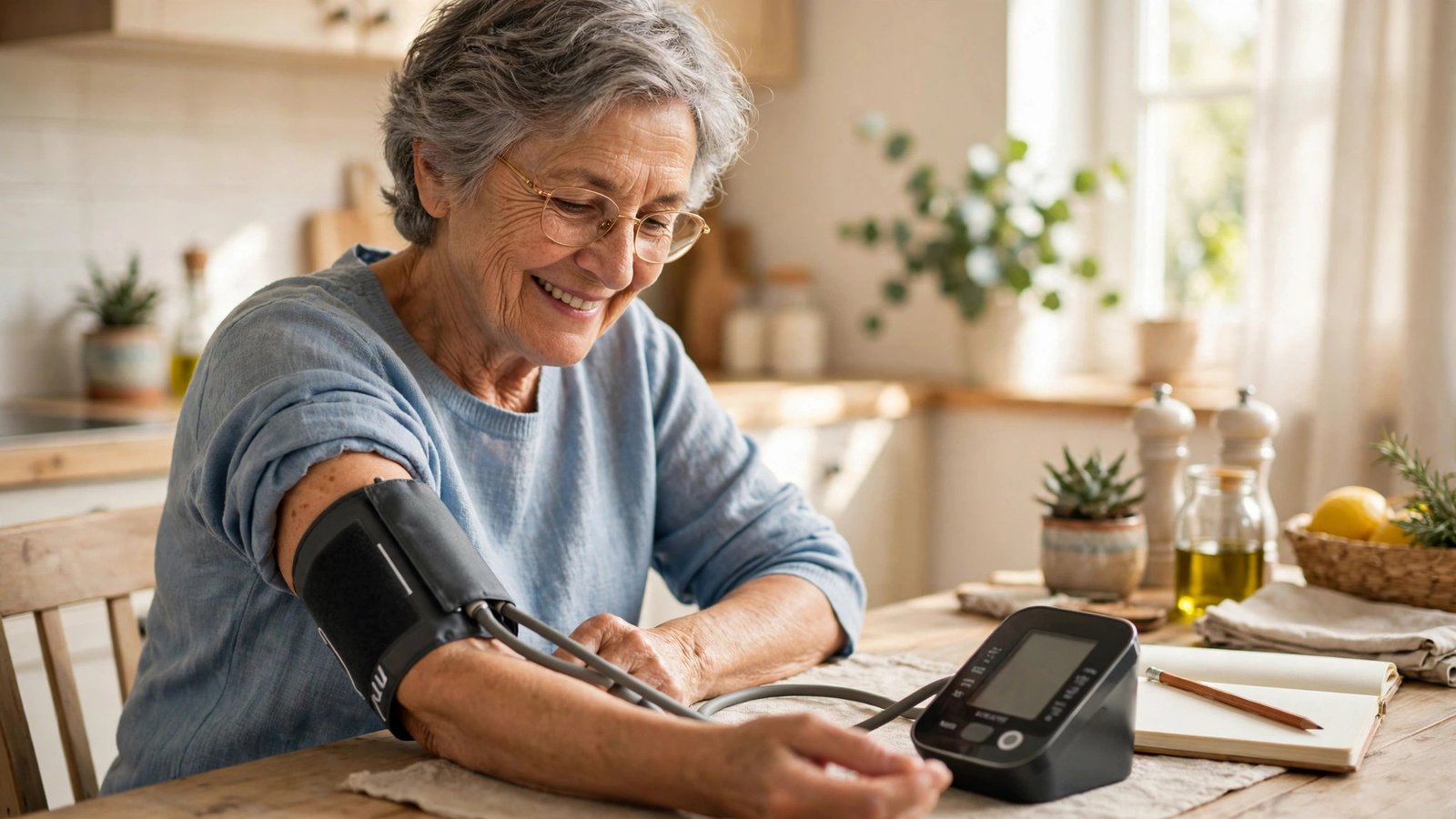
How to Check Your Blood Pressure at Home Correctly: A Step-by-Step Guide for Older Adults
How to Check Your Blood Pressure at Home Correctly: A Step-by-Step Guide for Older Adults A home blood pressure monitor is only as good as the way you use it. The short answer: choose a validated automatic upper-arm monitor with a cuff that fits, then measure at the same time each day, sitting quietly for…
How to Check Your Blood Pressure at Home Correctly: A Step-by-Step Guide for Older Adults
A home blood pressure monitor is only as good as the way you use it. The short answer: choose a validated automatic upper-arm monitor with a cuff that fits, then measure at the same time each day, sitting quietly for five minutes first, back supported, feet flat on the floor, legs uncrossed, the cuff on your bare upper arm at heart level — and take two readings, one or two minutes apart, and write both down. Done this way, your home numbers are among the most useful health information you can bring to your doctor. Done carelessly — cuff over a sleeve, legs crossed, talking, right after coffee — the same monitor can give you a number that is 10 or 20 points off, and that wrong number can lead to the wrong decisions.
This guide walks you through the whole process, step by step, using the current guidance from the CDC, the American Heart Association (AHA) and the National Institute on Aging (NIA). It covers choosing a monitor, the exact measuring routine, the mistakes that skew readings, what your numbers mean after age 60, how often to measure, and when a reading means you should call your doctor — or 911.
Important: This article is general information, not medical advice. It does not diagnose high blood pressure or replace your doctor’s guidance. Never start, stop or change a blood pressure medicine because of a home reading — always talk to your doctor or pharmacist first.
Why checking at home matters more after 50
High blood pressure is often called “the silent killer” because it usually has no warning signs or symptoms. The National Institute on Aging notes that high blood pressure affects nearly half of all adults, and many do not even know they have it. The only way to know your numbers is to measure them.
As we age, arteries naturally stiffen, and blood pressure tends to rise. The NIA explains that for older adults the most common pattern is isolated systolic hypertension — the top number is 130 or higher while the bottom number stays below 80 — caused by age-related stiffening of the major arteries. This pattern still raises the risk of heart disease, stroke, kidney disease, eye problems and vascular dementia, and it can also cause shortness of breath during light activity, lightheadedness when standing up too fast, and falls.
Home monitoring helps in three ways that a single office reading cannot:
- It catches white coat syndrome. The CDC reports that as many as 1 in 3 people who have a high reading in the doctor’s office have normal readings outside it — nervousness alone pushes the number up.
- It catches masked hypertension. Some people read normal in the office but high at home. Without home readings, that pattern is invisible.
- It shows the trend. One reading is a snapshot. A week of readings at the same time each day shows whether a treatment is working. The CDC notes that research shows people with high blood pressure are more likely to lower it when they use self-measured blood pressure monitoring together with support from their health care team.
The landmark SPRINT trial, funded by the National Institutes of Health, found that lowering systolic blood pressure to below 120 in adults age 50 and older significantly reduced the risk of cardiovascular disease and death — and a related analysis found a lower risk of mild cognitive impairment. That is why getting the number right matters: the number guides the plan.
What your blood pressure numbers mean
A blood pressure reading has two numbers, measured in millimeters of mercury (mm Hg). The first number, systolic pressure, is the pressure when your heart contracts and pushes blood out. The second number, diastolic pressure, is the pressure when your heart relaxes and fills with blood. A reading is written with the systolic number first, such as 120/80 mm Hg.
The American Heart Association uses these categories for adults:
Normal — Less than 120 systolic and less than 80 diastolic.
Elevated — 120–129 systolic and less than 80 diastolic.
Stage 1 hypertension (high blood pressure) — 130–139 systolic or 80–89 diastolic.
Stage 2 hypertension (high blood pressure) — 140 or higher systolic or 90 or higher diastolic.
Severe hypertension — call your health care professional — higher than 180 systolic and/or higher than 120 diastolic.
A single high reading does not diagnose high blood pressure. The NIA notes that if your reading is high at two or more check-ups, your doctor may ask you to measure your blood pressure at home. Only a doctor or other medical professional can confirm a diagnosis — and that diagnosis is based on a pattern of readings, not one number on one morning.
There is one exception to “wait and watch.” If a reading is above 180/120 mm Hg and you have symptoms such as chest pain, shortness of breath, back pain, numbness, weakness, a change in vision or difficulty speaking, that is a hypertensive emergency — call 911 immediately. Do not wait to see whether the number comes down on its own. (More on urgent readings later in this guide.)
Low blood pressure matters too. The NIA defines low blood pressure as a systolic reading below 90 or a diastolic reading below 60. If you feel lightheaded, weak or dizzy, or you faint, tell your doctor — it can be caused by not getting enough fluids, blood loss, some medical conditions, or medicines, including blood pressure medicines themselves. Staying well hydrated matters here: our guide to dehydration in older adults explains the warning signs that are easy to miss
Choosing the right home blood pressure monitor
This is the step most people rush — and the step that decides whether everything after it is trustworthy.
Buy an automatic, cuff-style, upper-arm monitor. The American Heart Association recommends an automatic upper-arm monitor for home use. Wrist and finger monitors are not recommended because they give less reliable readings. Smartwatches and rings that claim to measure blood pressure without a cuff have not been validated for diagnosis; in 2025 the FDA warned consumers not to rely on unauthorized devices that claim to measure blood pressure. A cuff on the upper arm is the standard for a reason.
Choose a validated monitor. “Clinically proven” on the box is marketing language, not proof. A validated monitor is one that has passed independent accuracy testing. The AHA points people to ValidateBP (validatebp.org), the American Medical Association’s free listing of monitors confirmed for clinical accuracy. If you are unsure, ask your doctor or pharmacist to recommend a validated model.
Get the cuff size right. This is the single most common equipment mistake. Measure around the middle of your upper arm and match it to the cuff’s size range. A cuff that is too small reads too high; a cuff that is too large reads too low. If you are choosing a monitor for a senior, a person who is pregnant or a child, make sure the monitor is validated for that group.
Bring it to your appointment. Once you have bought your monitor, take it to your next doctor visit. The AHA advises having your health care professional check that you are using it correctly and getting the same results as the office equipment. Plan to bring the monitor in about once a year, or as directed, so its accuracy can be re-checked.
What to spend: You do not need the most expensive model. A basic validated automatic upper-arm monitor from a pharmacy or reputable retailer is usually enough. Useful extras are a large, easy-to-read display, a cuff that fits your arm, and memory that stores readings (or an app that logs them). What matters is validation and fit, not extra features.

The step-by-step routine: how to check your blood pressure at home correctly
This is the routine the CDC and the AHA recommend. Follow it the same way every time — consistency is what makes home readings comparable from day to day.
Before you measure
- Avoid the things that raise a reading for 30 minutes beforehand. Do not smoke, drink alcohol or caffeinated drinks, or exercise within 30 minutes of measuring. Do not eat or drink anything for 30 minutes before you take your blood pressure either — the CDC lists this explicitly.
- Empty your bladder. A full bladder can raise your reading, so use the bathroom first.
- Rest quietly for at least five minutes. Sit in a comfortable chair and do nothing. No phone, no television, no conversation. Activity and talking both raise the number.
Sit correctly
- Sit with your back supported and both feet flat on the floor. Do not cross your legs — the CDC warns that crossing your legs can push your reading up. Do not sit on a stool or the edge of a bed with your back unsupported.
- Rest your arm on a table so the cuff is at heart level. Your arm should be supported on a flat surface, not hanging at your side. The middle of the cuff should sit at heart level, and the bottom of the cuff should be just above the bend of your elbow. If your arm is too low, prop a pillow underneath it.
- Place the cuff on your bare upper arm and make sure it fits snugly. Remove clothing from the arm — never measure over a sleeve. The cuff should be snug but not painfully tight before it inflates. Check your monitor’s instructions for an illustration, or ask your health care professional to show you.
Take the reading
- Stay still and silent, then press start. Do not talk while your blood pressure is being measured. Keep your arm still and your body relaxed. Breathe normally.
- Take two readings, one or two minutes apart, and record both. The CDC and the AHA both recommend at least two readings each time you measure, about one minute apart. If the two readings differ by more than a few points, take a third and note all three.
- Write the results down immediately, with the date and time. Record the numbers in a blood pressure log or notebook, or use your monitor’s memory or app. A number you meant to remember is a number you will forget. Bring the log to your appointments.
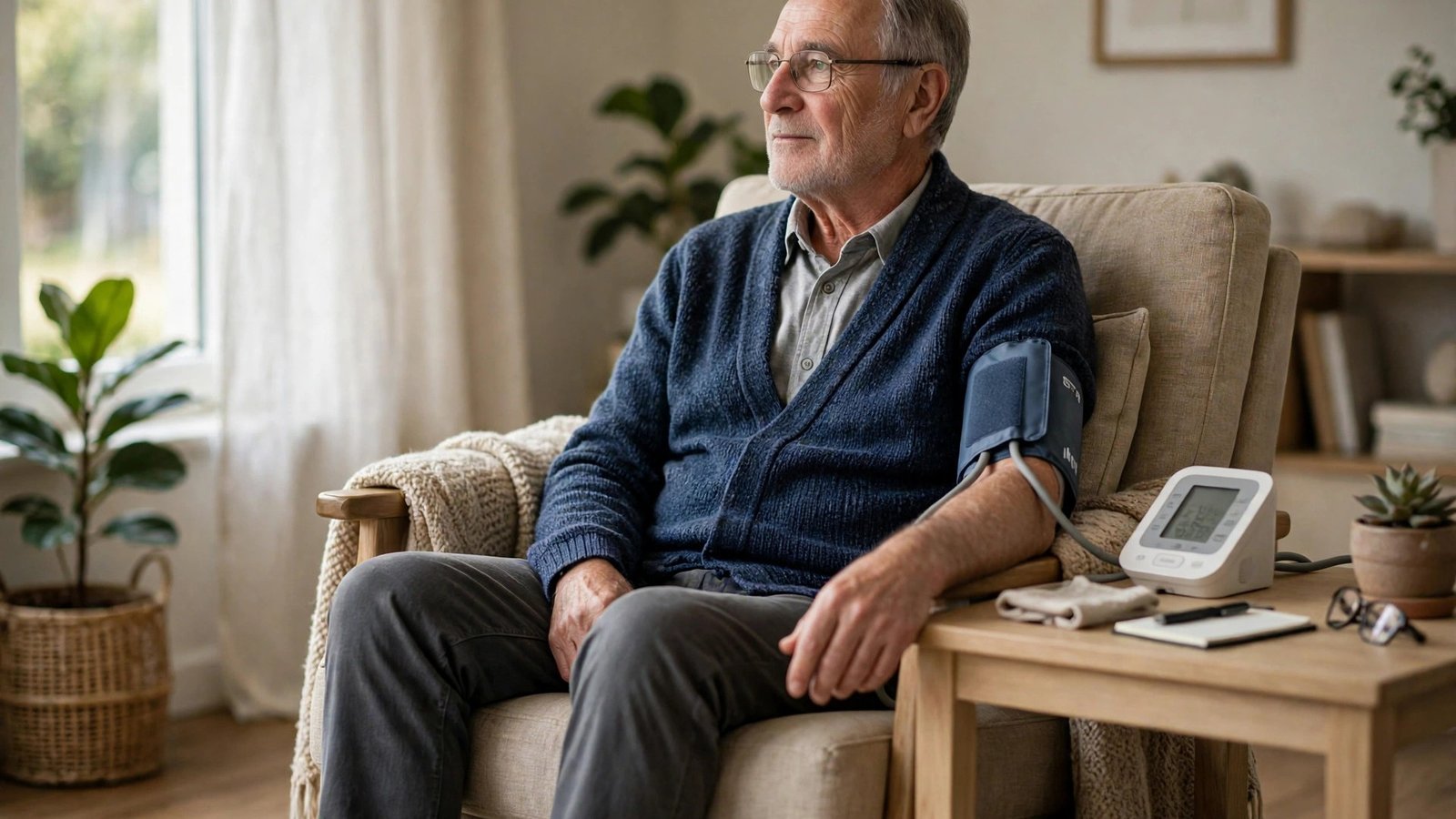
A quick-reference checklist
- No food, drink, caffeine, alcohol, smoking or exercise for 30 minutes before
- Bladder empty
- Five minutes of quiet rest
- Back supported, feet flat, legs uncrossed
- Cuff on bare upper arm, snug, at heart level, supported on a table
- No talking during the reading
- Two readings, one minute apart, both recorded with date and time
Print this list and keep it next to your monitor until the routine becomes habit. Most people need about two weeks of practice before it feels automatic.
10 common mistakes that make home readings wrong
Small errors add up. Here are the ones doctors see most often — and how to avoid each.
- Measuring over a sleeve. A cuff over clothing reads inaccurately. Always roll the sleeve up or remove the garment.
- The wrong cuff size. Too small reads high; too large reads low. Measure your arm and match the cuff range.
- Crossing your legs. This alone can raise systolic pressure noticeably. Feet flat, legs uncrossed, every time.
- An unsupported arm hanging at your side. The cuff must be at heart level, resting on a table. An arm left dangling reads higher.
- Talking during the reading. Even a short answer to a question can lift the number. Stay silent until the monitor finishes.
- Measuring right after activity, coffee or a cigarette. Walk up the stairs, drink coffee, smoke — then measure — and you are measuring the coffee, not your blood pressure. Wait 30 minutes.
- Not resting first. Sitting down and pressing start immediately gives a higher number than the same person five minutes later. Rest first.
- Taking only one reading. A single reading can be an outlier. Two readings, one minute apart, are the standard — and if they disagree, take a third.
- Using a wrist or finger monitor. These are more sensitive to position and tend to be less reliable. The AHA does not recommend them for routine home monitoring.
- Measuring at random times. Blood pressure changes through the day. Readings taken at different times are not comparable. Measure at the same time each day — the AHA recommends morning and evening readings for at least three days, and preferably seven, before an appointment.
If your numbers jump around a lot from day to day, do not assume the monitor is broken. Check your technique against this list first, then bring the monitor to your next appointment and compare it with the office equipment.
When and how often should you measure?
There is no single schedule for everyone — it depends on why you are measuring. Ask your health care professional what schedule fits your situation, but these are the common patterns:
- If you have just been diagnosed, or your medicine has changed: twice a day — once in the morning before taking any medicines, and once in the evening — for at least three days, and preferably seven, before your next appointment. This is the schedule the AHA suggests for a pre-appointment log, and it gives your doctor a real picture instead of a single snapshot.
- If your blood pressure is stable and controlled: less often may be enough — perhaps a few readings a week, or as your doctor advises. The point is to keep a light, regular check so a slow drift upward is caught early.
- If your doctor asks you to monitor for a diagnosis: follow their exact schedule. Home readings are often the evidence that confirms — or rules out — high blood pressure, so the timing matters.
Whatever schedule you use, measure at the same time each day, and note the time alongside the numbers. A morning reading and an evening reading are different measurements; comparing them as if they were the same thing creates confusion, not clarity.
One more timing point: do not measure when you are in pain, very anxious, or unwell unless your doctor has asked you to. Those readings will be high for reasons that have nothing to do with your usual blood pressure, and they can cause unnecessary worry.
Keeping a blood pressure log your doctor can actually use
A log turns isolated numbers into evidence. The CDC provides a printable blood pressure log, and the AHA offers a printable tracker — or a plain notebook works just as well. What matters is that you record the same things every time:
- Date and time of each reading
- Both readings (systolic and diastolic) for each measurement
- Your pulse, if your monitor shows it
- Anything relevant that day — for example, “missed morning medicine,” “slept badly,” “new medicine started,” or “felt dizzy”
Bring the log — or the monitor itself, if it stores readings — to every appointment. The AHA notes that if your monitor has built-in memory, bringing it lets your doctor see the full record, and some monitors let you upload readings to a secure website. A paper log is just as good, and many doctors prefer it because it is easy to scan in seconds.
If you keep your log on paper, keep it in the same place as the monitor so recording becomes part of the routine rather than a separate chore. And if a family member helps you with your health, make sure they know where the log lives — after a fall or a hospital visit, it is often the family who needs to find it. Our room-by-room fall prevention checklist for seniors at home covers how to make the home safer in exactly those situations

What to do about a high reading
A single high reading is not an emergency and not a diagnosis. The AHA advises: take your blood pressure a second time, write down both results, and check with your health care professional about whether there is a concern or a problem with your monitor.
If the reading is above 180/120 mm Hg: wait at least one minute and test again. If it is still very high, contact your health care professional immediately — you could have severe hypertension. If the high reading comes with chest pain, shortness of breath, back pain, numbness, weakness, a change in vision or difficulty speaking, call 911 right away. This is a hypertensive emergency. Do not wait to see whether the number comes down on its own.
If your readings are creeping up over days or weeks: bring the log to your doctor and discuss it. Do not adjust your medicine on your own — never stop taking blood pressure medicine because a home reading looked good, and never take an extra dose because a reading looked bad. The AHA is explicit: do not stop taking blood pressure medication without checking with your health care professional, whatever your home readings show.
If your readings are consistently normal: that is good news, and it is also information. Keep measuring on your doctor’s schedule, because blood pressure can change with age, weight, medicines and other health conditions. A good run of readings is a reason to keep monitoring, not a reason to stop.
Lowering blood pressure day to day — what actually helps
Home monitoring is only half the job; the other half is the daily habits that move the numbers. The NIA lists the lifestyle changes with the strongest evidence for older adults:
- Move more. Moderate activity such as brisk walking or swimming can lower blood pressure. Work up to at least 150 minutes (2.5 hours) a week, and check with your doctor before starting an exercise plan if you have untreated health problems. Our beginner’s guide to strength training for seniors is a safe place to start building activity into the week
- Eat a heart-healthy diet. A balanced diet of vegetables, fruits, grains, protein, dairy and oils — such as the DASH eating plan — can lower blood pressure. DASH is also low in salt.
- Cut down on salt. As you get older, your body and blood pressure become more sensitive to sodium, which is added to many foods during processing or preparation. Limiting salt each day may help.
- Drink less alcohol. For those who drink, the NIA advises no more than two drinks a day for men and one a day for women to lower the risk of high blood pressure.
- Do not smoke. Smoking raises the risk of high blood pressure, heart disease, stroke and other health problems. The health benefits of quitting can be seen at any age — you are never too old to quit.
- Get good sleep. Tell your doctor if you have been told you snore or stop breathing during sleep — this may be sleep apnea, and treating it can help lower blood pressure. Our guide to how much sleep you need after 50, 60 and 70 includes a senior sleep routine that supports healthier readings
- Manage stress. Coping with problems and reducing stress can help lower blood pressure.
- Aim for a healthy weight. Being overweight adds to the risk of high blood pressure.
Medication is often part of the plan as well. The NIA notes that isolated systolic hypertension — the most common pattern in older adults — is treated the same way as regular high blood pressure, but it may need more than one type of medicine, and you may try several kinds or combinations before finding a plan that works. Medication can control blood pressure, but it cannot cure it — if your doctor starts you on medicine, you may need to take it long term. The NIA’s practical tips for taking blood pressure medicine include: take it at the same time each day as part of your routine; get up slowly from a seated or lying position and stand for a bit before walking, to let your blood pressure adjust and prevent lightheadedness and falls; tell your doctor about all the drugs you take, including over-the-counter medicines, vitamins and supplements, because they can affect your blood pressure and change how well your medicine works; and refill before you run out.
Heart-healthy eating also supports the bigger picture. Omega-3 fats from fish are part of many heart-healthy eating patterns — our guide to omega-3 for heart health over 60 covers food sources, dose and the blood-thinner warnings that matter if you take anticoagulants
Frequently asked questions
1. What is the correct way to check blood pressure at home?
Sit in a chair with your back supported for at least five minutes, feet flat on the floor and legs uncrossed. Place the cuff on your bare upper arm, snug, with the middle of the cuff at heart level and your arm resting on a table. Do not eat, drink, smoke, exercise or use caffeine for 30 minutes beforehand, empty your bladder, stay still and silent, then take two readings one or two minutes apart and record both. That is the routine recommended by the CDC and the American Heart Association.
2. Should I use my left or right arm?
The AHA says you can use either arm — usually there is not a big difference between readings on them. What matters is consistency: use the same arm every time so your readings are comparable. If your doctor finds a large or persistent difference between arms, follow their advice on which arm to use.
3. Are wrist blood pressure monitors accurate?
Generally less accurate than upper-arm monitors. The American Heart Association does not recommend wrist or finger monitors for routine home use because they give less reliable readings, and they are very sensitive to wrist position. If you can only use a wrist monitor, ask your doctor or pharmacist whether it is a validated model and how to position it correctly.
4. What is a normal blood pressure reading for someone over 60?
For most adults, normal is less than 120/80 mm Hg. Elevated is 120–129 with a diastolic below 80; stage 1 hypertension is 130–139 or 80–89; stage 2 is 140 or higher, or 90 or higher. Your doctor may set a personal target based on your age, other health conditions and overall fitness — the SPRINT trial supported a systolic target below 120 for many adults over 50, but targets are individual, so ask your doctor what yours is.
5. How often should I check my blood pressure at home?
It depends on your situation. The AHA suggests morning and evening readings for at least three days, and preferably seven, before an appointment when a diagnosis or a treatment change is being assessed. If your blood pressure is stable, your doctor may advise a lighter schedule, such as a few readings a week. Always follow your doctor’s schedule rather than measuring constantly — more readings are not better readings.
6. Why is my blood pressure higher at the doctor’s office than at home?
That is often white coat syndrome — nervousness about having your blood pressure taken. The CDC reports that as many as 1 in 3 people with a high office reading have normal readings outside the office. Home readings taken with the correct technique help your doctor tell the difference between white coat syndrome, masked hypertension and true high blood pressure.
7. Can I check my blood pressure right after eating or drinking coffee?
You should not. The CDC advises not eating or drinking anything for 30 minutes before a reading, and not smoking, drinking alcohol or caffeine, or exercising within 30 minutes. Coffee, food and activity all raise blood pressure temporarily and will make the reading misleading.
8. When should I call a doctor about a home blood pressure reading?
Call your health care professional if readings stay above 180/120 mm Hg after a repeat measurement, or if your readings are creeping up over days or weeks. Call 911 immediately if a reading above 180/120 comes with chest pain, shortness of breath, back pain, numbness, weakness, a change in vision or difficulty speaking. And never change, stop or add a blood pressure medicine because of a home reading — always check with your doctor first.
Conclusion
Checking your blood pressure at home is a small skill with a large payoff — but only if the technique is right. A validated automatic upper-arm monitor, the correct cuff size, five minutes of quiet rest, the right sitting position, two readings a minute apart and a written log: that is the whole routine, and it takes less than ten minutes a day. The reward is numbers you and your doctor can trust — numbers that catch problems early, show whether treatment is working, and spare you from decisions based on a reading that was wrong because of a crossed leg or a sleeve.
Start today. Check your monitor is validated, measure your arm for the right cuff, and take your first proper reading tomorrow morning at the same time you will measure each day. Bring your log to your next appointment and let your doctor see the pattern — that conversation is where home monitoring earns its keep.
Disclaimer: This article is for general information only and is not medical advice. Blood pressure targets, monitoring schedules and medicines are individual decisions. Talk to your doctor or pharmacist before starting, stopping or changing any blood pressure medicine, and seek urgent care if you have a reading above 180/120 mm Hg with symptoms such as chest pain, shortness of breath or difficulty speaking.
Sources
- Centers for Disease Control and Prevention — Measuring Your Blood Pressure: https://www.cdc.gov/high-blood-pressure/measure/
- American Heart Association — Home Blood Pressure Monitoring: https://www.heart.org/en/health-topics/high-blood-pressure/understanding-blood-pressure-readings/monitoring-your-blood-pressure-at-home
- National Institute on Aging — High Blood Pressure and Older Adults: https://www.nia.nih.gov/health/high-blood-pressure/high-blood-pressure-and-older-adults







2 Comments