

Balance Problems After 50: Causes, Tests and Exercises That Reduce Fall Risk
Feeling unsteady on your feet is not just “part of getting older” — and it is not something to ignore. Balance problems after 50 are common, but they are also one of the most fixable health problems of later life. The short answer: most balance trouble comes from a mix of weaker leg muscles, changes…
Feeling unsteady on your feet is not just “part of getting older” — and it is not something to ignore. Balance problems after 50 are common, but they are also one of the most fixable health problems of later life. The short answer: most balance trouble comes from a mix of weaker leg muscles, changes in the inner ear, poorer vision, certain medicines, and health conditions such as diabetes or low blood pressure on standing. Simple at-home balance tests can tell you where you stand, and regular balance and strength exercises — done three times a week — can cut your risk of falling by roughly a quarter, according to a large review of 108 trials. This guide explains the causes, the tests, the exercises, and the warning signs that mean you should see a doctor.
Medical disclaimer: This article is general information only and is not medical advice. Balance problems can be a sign of a serious condition. Talk to your doctor before starting any new exercise programme, especially if you have fallen, feel dizzy, or have a heart condition, low blood pressure, or a neurological condition. If you feel faint, have chest pain, or cannot breathe during exercise, stop and seek medical help right away.
Why Balance Matters So Much After 50
Falls are the leading cause of injury and injury-related death for older adults in the United States. More than one in four people aged 65 and older fall each year, and over 3 million are treated in emergency departments annually for fall injuries, according to the CDC’s STEADI programme. The National Institute on Aging (NIA) reports the same one-in-four figure and notes that a fall can break a bone — and for an older adult, a broken bone can be the start of long-term disability.
Here is the hopeful part: many falls can be prevented. The NIA lists exercise, managing medicines, having your vision checked, and making your home safer as steps that lower your risk. And the evidence for exercise is strong. A 2019 Cochrane review of 108 randomised trials with more than 23,000 community-dwelling older adults found that exercise programmes reduced the rate of falls by 23%, and balance and functional exercises alone cut the rate of falls by 24%. Those are group averages, not a guarantee for any one person — but they show that balance is trainable at almost any age.
There is another, quieter cost to balance problems: fear. Many older adults who feel unsteady start avoiding walking, shopping, or social activities. That avoidance weakens muscles further and makes balance worse — a cycle the NIA specifically warns against. Staying active, with the right precautions, is part of the treatment, not something to stop doing.
At a glance — balance after 50:
| Fact | What the evidence says |
|---|---|
| How common are falls? | More than 1 in 4 adults 65+ falls each year (CDC, NIA) |
| Emergency care | Over 3 million ED visits a year for fall injuries (CDC) |
| Can exercise help? | Exercise programmes cut the fall rate by about 23% (Cochrane review, 2019) |
| Balance exercise alone | Balance and functional exercises cut the fall rate by about 24% |
| How often to practise | About 3 balance sessions a week, per the NIA |
| The catch | Fear of falling can make people less active, which makes balance worse |
How Balance Actually Works
Balance is not one sense — it is a team effort by three systems, coordinated by your brain:
- Your inner ear (the vestibular system). Tiny fluid-filled canals and sensors in your inner ear tell your brain which way is up and how your head is moving. This is your fastest balance system, and the one most affected by age and by conditions such as BPPV (benign paroxysmal positional vertigo).
- Your vision. Your eyes tell your brain where you are in relation to walls, steps, and the ground. Poor vision, cataracts, or even a new pair of glasses you have not adjusted to can throw balance off.
- Your sense of body position (proprioception). Nerves in your feet, ankles, legs, and joints constantly report where your body parts are without you looking. Diabetes-related nerve damage (neuropathy), numb feet, and stiff ankles weaken this system.
Your brain combines these three streams of information in a fraction of a second and tells your muscles to correct your posture. When one system weakens, the others can often compensate — which is why balance training works. But when two or more systems decline at once, or a medicine blunts the brain’s processing, unsteadiness shows up.
Think of it like a three-legged stool. Lose one leg and the stool wobbles; strengthen the other two and it can still stand. Balance exercises, stronger leg muscles, better vision, and a medicine review are all ways of reinforcing the legs you still have.
What Causes Balance Problems After 50
There is rarely a single cause. Most people have two or three factors working together. Here are the main ones, roughly in order of how common they are.
1. Muscle loss (sarcopenia)
Age-related muscle loss begins in your 40s and speeds up after 60. Weaker leg and hip muscles react more slowly when you trip or step on an uneven surface, and weak ankles cannot correct a wobble quickly enough. The NIA notes that sarcopenia, balance and gait problems, and blood pressure that drops on standing are all risk factors for falling. The good news: muscle responds to strength training at any age, and even small gains help.
2. Inner-ear problems
The vestibular system ages too. The most common inner-ear cause of dizziness after 50 is BPPV — tiny calcium crystals in the inner ear drift out of place and trigger brief spinning sensations when you roll over in bed, look up, or bend down. Other inner-ear causes include Ménière’s disease, vestibular neuritis (often after a viral illness), and age-related wear of the balance organs. Inner-ear dizziness is often brief and triggered by head movement, which is a useful clue for your doctor.
3. Vision problems
Cataracts, glaucoma, macular degeneration, and even an out-of-date glasses prescription reduce the visual information your brain uses to stay upright. Bifocal and progressive lenses can also be a problem: the lower part of the lens is made for reading, so looking down at steps through it distorts depth. The NIA advises taking time to get used to new glasses and wearing them as your eye doctor advises — and getting your eyes tested regularly.
4. Medicines
Some medicines cause dizziness, sleepiness, or a drop in blood pressure. The NIA warns that the more medicines you take, the more likely you are to fall. Common culprits include blood-pressure medicines, water pills (diuretics), sleeping pills, anxiety medicines, some antidepressants, pain medicines, and drugs for an overactive bladder. Never stop a prescribed medicine on your own — but do ask your doctor or pharmacist for a full medicine review if you feel unsteady, and mention every over-the-counter product and supplement you take.
5. Blood pressure that drops when you stand (postural hypotension)
When you stand up, blood normally rushes to your legs, and your body tightens blood vessels to keep blood flowing to the brain. With age, dehydration, some medicines, or conditions such as diabetes, this response slows down. The result: lightheadedness or a grey-out for a few seconds after standing. The NIA advises standing up slowly and having your blood pressure checked while lying down and standing.
6. Chronic health conditions
Diabetes can damage the nerves in your feet, so you feel the ground less clearly. Heart disease and irregular heart rhythms can reduce blood flow to the brain. Stroke, Parkinson’s disease, multiple sclerosis, and other neurological conditions affect coordination directly. Thyroid problems, vitamin B12 deficiency, and inner-ear infections can also disturb balance. This is why new or worsening unsteadiness deserves a medical check rather than being written off as age.
7. Nerve damage in the feet (peripheral neuropathy)
Numbness, tingling, or a “walking on cotton wool” feeling in the feet means the proprioception system is sending poor signals. Neuropathy is common with diabetes, long-term heavy alcohol use, vitamin B12 deficiency, and some chemotherapy drugs. Supportive shoes, checking your feet daily, and treating the underlying cause all matter.
8. Dehydration, poor sleep, and alcohol
Being short of fluids lowers blood volume and blood pressure, which worsens dizziness on standing. Poor sleep slows reaction time — the NIA lists getting enough sleep among its fall-prevention tips. Alcohol affects the inner ear and the brain’s coordination, and even one or two drinks can make balance noticeably worse in older adults. The NIA advises avoiding or limiting alcohol.
9. Foot problems and footwear
Painful feet, bunions, and stiff ankles change how you walk. Backless shoes, high heels, smooth-soled slippers, and walking in socks on hard floors all increase slip risk. The NIA recommends nonskid, rubber-soled, low-heeled shoes that fully support your feet.

Early Warning Signs to Watch For
Balance problems often start subtly — months before a first fall. Catching them early is the whole point of this guide. Watch for:
| Warning sign | What it may look like in daily life |
|---|---|
| Feeling unsteady when walking | Swaying, veering to one side, or needing to concentrate hard to walk straight |
| Holding onto furniture | Touching walls, counters, or furniture “just in case” as you move around the house |
| Difficulty walking in a straight line | Trouble with heel-to-toe walking or drifting sideways on a pavement |
| Dizziness when standing up | Lightheadedness or a brief grey-out in the first seconds after standing |
| Fear of falling | Avoiding stairs, showers, outings, or uneven ground because you feel unsafe |
| Needing more time to get up | Pushing hard on chair arms to stand, or feeling wobbly for the first steps |
| Near-falls | Tripping, stumbling, or catching yourself on furniture — even if you did not hit the ground |
| A recent fall | Any fall, even without injury — tell your doctor, even if you feel fine |
A near-fall counts. So does a fall with no injury. The NIA is explicit: always tell your doctor if you have fallen since your last check-up, even if you did not feel pain. A fall can alert your doctor to a new medical problem or a medicine or eyesight issue that can be corrected.
Simple Balance Tests You Can Do at Home
These are screening checks, not diagnoses. They help you notice change over time and give your doctor something concrete to work with. Do them next to a sturdy counter or heavy chair, in flat, supportive shoes or bare feet on a non-slip floor, with someone nearby if you can. Stop if you feel dizzy or unsafe, and do not test yourself if you have already fallen recently — ask your doctor or a physical therapist to assess you instead.
1. Single-leg stand
Stand behind a sturdy chair and hold on lightly. Lift one foot off the floor and balance on the other leg. Time how long you can hold it without putting the foot down or grabbing the chair. Try the other leg. Many healthy adults in their 60s can hold 10 seconds or more per leg; if you cannot hold 5 seconds on either leg, or one side is much worse than the other, mention it to your doctor. Repeat once a month to track change — not daily, which only invites frustration.
2. Heel-to-toe walk (tandem walk)
Stand near a wall or counter. Place the heel of one foot directly in front of the toes of the other, as if walking a tightrope. Take 10 slow steps forward in that heel-to-toe pattern, keeping your arms out or lightly touching the wall. Swaying, stepping sideways, or needing to grab support is information, not failure — it tells you this is a skill worth practising.
3. Sit-to-stand test
Sit in a straight-back chair with your feet flat on the floor. Without using your hands, stand up, then sit back down slowly. Repeat 5 times and note how long it takes and how steady you feel. Difficulty here usually points to leg strength rather than the inner ear — and strength is very trainable.
4. Timed Up and Go
This is the test doctors and physical therapists use most, and you can try a simplified version at home. Sit in a chair, stand up, walk 10 feet (about 3 metres) at your normal pace, turn around, walk back, and sit down. Time it. Taking more than about 12 seconds, or feeling unsteady during the turn, is a reason to ask your doctor for a formal assessment. Do not attempt this alone if you feel unsteady — have someone with you.
5. Standing with eyes closed (Romberg-style check)
Stand with your feet together, arms at your sides, next to a counter you can grab. Close your eyes for 10 seconds. Some sway is normal; a big sway, stepping out, or needing to grab the counter suggests your balance relies heavily on vision, which means your inner ear or foot-sensation systems may need attention. Only do this with support within reach and someone nearby.
What the results mean: These tests do not diagnose anything. A poor result is a prompt to see your doctor, not a verdict. Bring your notes — “I can stand on my right leg for 12 seconds but only 3 on my left” is far more useful to a clinician than “I feel wobbly.”
Balance Exercises That Actually Work
The exercises below follow the NIA’s and MedlinePlus’s guidance for older adults: do them next to a sturdy chair, counter, or wall; go slowly; stop if you feel pain, dizziness, or breathlessness; and check with your doctor first if you have a heart condition, low blood pressure, or a neurological condition. Aim for about three balance sessions a week, alongside muscle-strengthening work on at least two days and regular walking, per the NIA’s three-types-of-exercise guidance.
1. Single-leg stand (the foundation)
Stand behind a sturdy chair, holding on with both hands. Lift one foot and balance on the other for up to 10 seconds, then switch legs. Repeat 10–15 times per leg, as MedlinePlus advises. As you get steadier, progress in small steps: hold with one hand, then one finger, then no hands — but only when you are steady at each stage. Do it while waiting for the kettle to boil and it becomes a habit, not a chore.
2. Heel-to-toe walk
Walk in a straight line, placing the heel of one foot directly in front of the toes of the other, arms out for balance or lightly touching a wall. Take 10–20 steps. The NIA lists the heel-to-toe walk among its recommended balance exercises, along with walking backward or sideways. Start on a clear hallway with a wall on one side.
3. Toe stand (calf raises)
Hold a solid support, stand with your back straight, and bend both knees slightly. Rise onto your tiptoes as high as you can, then lower your heels slowly. Repeat 10–15 times. MedlinePlus recommends this for calf and ankle strength — strong ankles are your first line of defence when you wobble.
4. Knee curl (hamstring curl)
Holding the back of a chair, stand with feet shoulder-width apart and knees slightly bent. Lift one leg straight back, bend the knee, and bring your heel toward your buttock. Lower slowly. Repeat 10–15 times with each leg. This strengthens the backs of the thighs and the lower back.
5. Sit-to-stand
Sit in a straight-back chair, feet flat on the floor. Stand up without using your hands, then sit back down slowly and with control. Repeat 10–15 times. This is both a test and an exercise: it builds the thigh and hip strength you use every time you get out of a chair, a car, or bed. If you cannot do it without hands yet, use one hand — and work toward none.
6. Side leg raises
Holding a chair, lift one leg out to the side, keeping your back straight and your toe pointing forward. Lower slowly. Repeat 10–15 times per leg. Strong hip muscles keep you upright when you step sideways or shift your weight.
7. Balance walk
Walk in a straight line, lifting each knee a little higher than normal and pausing for a second on one foot before the next step — like slow marching. This is the NIA’s “balance walk,” and it trains the same weight-shifting you use on stairs and kerbs.
8. Tai chi
Tai chi is a slow, flowing “moving meditation” that shifts weight gently from leg to leg while breathing deeply. The NIA lists tai chi among the best balance activities, and MedlinePlus calls it a good exercise for healthy adults to develop balance. It is the only exercise on this list with trial evidence behind it as a standalone fall-prevention programme, and many community centres and senior centres run beginner classes. If a class is not available, the NIA’s YouTube channel and other reputable sources offer guided sessions — start with a short seated or supported version if you are unsteady.

A 4-Week Starter Plan
Do not try everything on day one. Build up gradually, and keep a sturdy chair or counter within reach for the first two weeks.
| Week | Balance (3× per week) | Strength (2× per week) | Walking |
|---|---|---|---|
| Week 1 | Single-leg stand (holding chair, 5 reps per leg) + heel-to-toe walk, 10 steps | Sit-to-stand, 5 reps + toe stands, 10 reps | 10 minutes, flat ground, daily |
| Week 2 | Single-leg stand (one hand, 10 reps) + balance walk, 10 steps | Sit-to-stand, 10 reps + knee curls, 10 reps per leg | 15 minutes, daily |
| Week 3 | Single-leg stand (one finger, 10–15 reps) + heel-to-toe walk, 20 steps | Add side leg raises, 10 reps per leg | 20 minutes, include a gentle slope |
| Week 4 | Single-leg stand (no hands if steady) + tai chi session or balance walk, 20 steps | Full set: sit-to-stand, toe stands, knee curls, side leg raises | 30 minutes most days, aiming toward 150 minutes a week |
Progress is rarely a straight line. Some days will feel worse than others — illness, poor sleep, or a new medicine can all set you back temporarily. What matters is the trend over a month, not any single session. If your single-leg stand time improves from 4 seconds to 8 seconds over four weeks, that is real progress.
Common Mistakes That Make Balance Worse
- Holding your breath during exercises. Breathe slowly and easily; never hold your breath, as MedlinePlus advises. Holding your breath raises blood pressure and can make you lightheaded.
- Practising without support nearby. Confidence is good; overconfidence causes falls. Always have a chair, counter, or wall within reach, especially in the first weeks.
- Doing too much, too fast. Jumping to eyes-closed or no-hands exercises before you are steady invites a fall. Progress in small steps.
- Stopping activity because of fear. Fear of falling is understandable, but avoiding activity weakens muscles and worsens balance. Supervised, supported practice is safer than inactivity.
- Ignoring medicines. If a new medicine makes you dizzy, tell your doctor or pharmacist promptly instead of just “getting used to it.” A dose or timing change often fixes it.
- Wearing the wrong shoes. Backless slippers, smooth soles, and high heels are a fall risk. Wear low-heeled, rubber-soled shoes that fit well — even indoors.
- Getting up too fast. Stand up slowly, sit on the edge of the bed for a moment, and let your blood pressure catch up before walking.
- Skipping eye and hearing checks. Balance depends on vision and hearing more than most people realise. An outdated prescription or an ill-fitting hearing aid quietly undermines stability.
- Exercising only your legs. Balance needs the whole chain: ankles, hips, core, and even neck flexibility for turning your head. Mix balance, strength, and walking.
- Treating a fall as “nothing.” Every fall — and every near-fall — is information. Tell your doctor.
Making Your Home Safer
Exercise is only half the job. The NIA and CDC both stress fall-proofing your home, because most falls happen at home, in familiar rooms, doing ordinary things. For a full room-by-room checklist, see our Fall Prevention for Seniors at Home: A Room-by-Room Safety Checklist. The highest-impact changes:
- Remove trip hazards: loose rugs, electrical cords across walkways, clutter on stairs, and low furniture in walking paths. Tape down rug edges or remove the rug.
- Light the way: night lights in hallways, the bathroom, and the bedroom; a lamp or torch within reach of the bed; brighter bulbs on stairs. Poor lighting is a major fall factor.
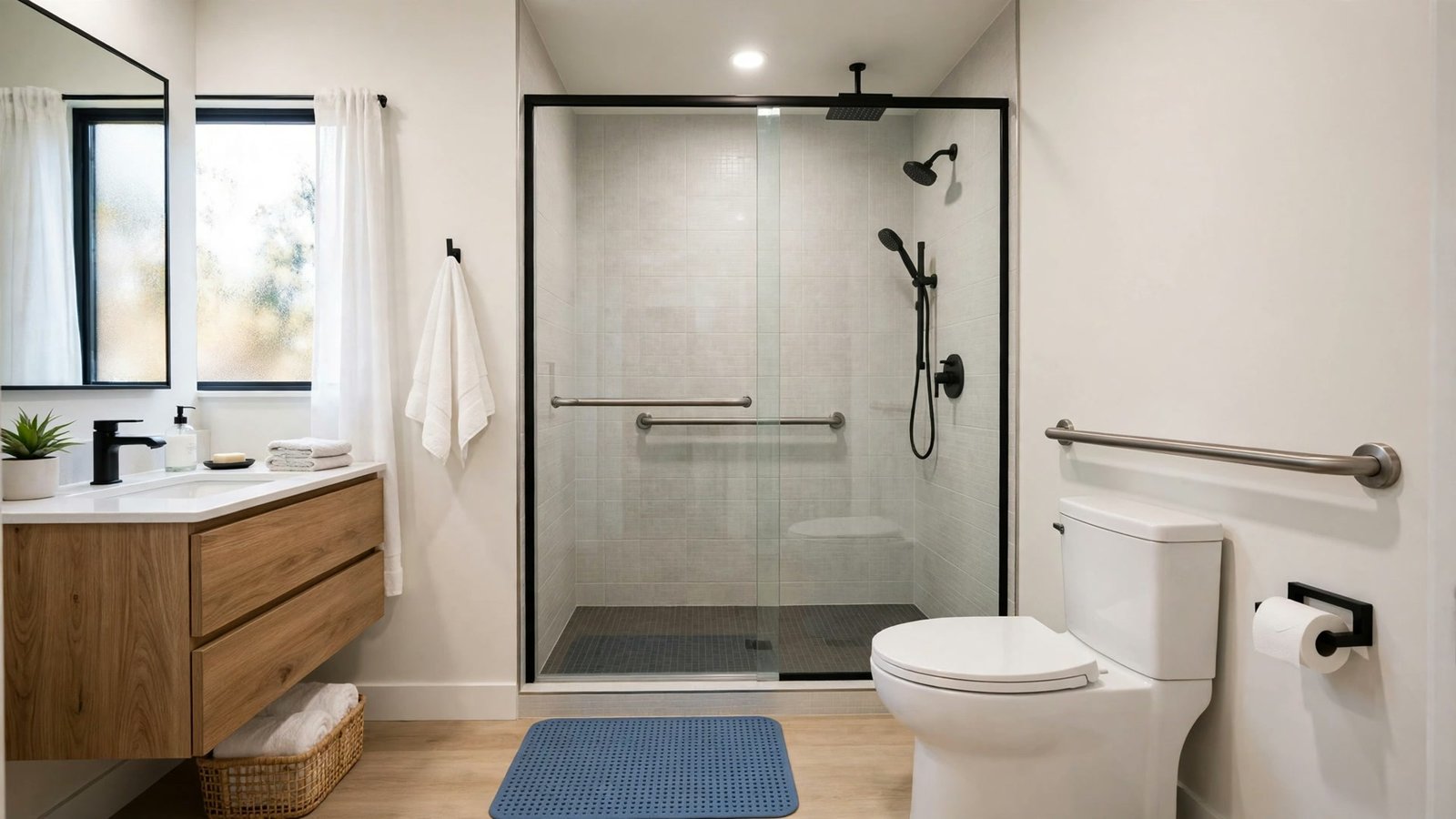
- Add grab bars: in the shower, beside the toilet, and at the top and bottom of stairs. Towel rails are not grab bars — they are not fixed to take your weight.
- Bathroom: a non-slip mat in the bath or shower, a shower chair if standing is hard, and a raised toilet seat if rising is difficult.
- Stairs: handrails on both sides, no objects stored on steps, and contrasting tape on the edge of the top and bottom steps so you can see them clearly.
- Kitchen: keep everyday items at waist height so you do not need a step stool; wipe up spills immediately; wear shoes, not socks, on hard floors.
- Outdoors: keep paths clear of leaves and ice, use an ice-melt product in winter, and wear shoes with good grip. Consider staying inside in bad weather — many pharmacies and grocery services deliver.
Medicines, Vision, Hearing, and Footwear — the Quick Checks
These four checks are cheap, quick, and often the real fix behind “mysterious” unsteadiness:
- Medicine review: Ask your doctor or pharmacist to review everything you take — prescription, over-the-counter, and supplements — at least once a year, and after any fall or new dizziness. Ask specifically about medicines that cause drowsiness or lower blood pressure.
- Vision check: Have your eyes tested at least once a year. Tell the optometrist about balance problems, and be careful on stairs in new bifocal or progressive lenses until you adjust.
- Hearing check: Even mild hearing loss affects balance, because the balance organs sit in the inner ear next to the hearing organs. If you have hearing aids, make sure they fit well and wear them — see our guide to Hearing Aids in 2026: OTC vs Prescription, Costs in the USA.
- Footwear: Non-slip, rubber-soled, low-heeled shoes that support your feet. Avoid backless shoes, high heels, and smooth-soled slippers. Have your feet checked regularly if you have diabetes.
- Sleep: Tiredness slows reactions. The NIA lists getting enough sleep as a fall-prevention step. Our guide to how much sleep you need after 50, 60 and 70 covers healthy sleep routines.
- Strength: Balance sits on a base of leg strength. Our Strength Training for Seniors: A Safe Beginner Guide for Ages 60–80 explains how to start safely, and our sarcopenia guide explains the muscle loss behind much of the problem.
What to Do If You Fall
A fall is frightening, and the first minute matters. The NIA advises:
- Breathe. Take several slow, deep breaths and stay still for a few moments to get over the shock.
- Check whether you are hurt. Getting up too quickly or the wrong way can make an injury worse. Do not rush.
- If you think you can get up safely: roll onto your side, rest, then get onto your hands and knees and crawl to a sturdy chair. Put your hands on the chair seat, slide one foot flat on the floor, and slowly rise and turn to sit in the chair.
- If you are hurt or cannot get up: call for help or call 911. If you are alone, try to get into a comfortable position and wait for help.
- Prepare in advance: keep a well-charged mobile or cordless phone with you at all times, arrange a daily check-in with a family member or friend, and consider a personal emergency response system — a button on a necklace or bracelet that calls for help. Some smartwatches have fall detection too.
- After any fall, tell your doctor — even if you feel fine. A fall can be the first sign of a new medical problem, a medicine side effect, or a vision change that can be corrected.
When to See a Doctor
Book an appointment promptly if you notice any of these:
- You have fallen, even once, or had a near-fall
- Dizziness or spinning that is new, frequent, or lasts more than a few minutes
- Balance problems that came on suddenly
- Unsteadiness with new numbness, weakness, slurred speech, or vision changes — seek urgent care for these
- Fainting or feeling about to faint
- Balance problems after starting a new medicine
- Fear of falling that is stopping you from leaving the house or doing daily activities
Your doctor may check your blood pressure lying down and standing, review your medicines, test your vision and hearing, check your vitamin B12 level and blood sugar, and refer you to a physical therapist or an ear, nose and throat specialist. A physical therapist can assess your gait and balance formally and build a programme around your specific weak points — this is often the single most useful referral for balance problems.
Frequently Asked Questions
1. Is losing your balance after 50 normal?
Some decline in balance with age is common, because muscles weaken, the inner ear ages, and reaction times slow. But frequent unsteadiness, dizziness, or falls are not something to accept as “just aging.” In most cases, a cause can be found — medicines, vision, blood pressure, muscle weakness, or an inner-ear problem — and balance can be improved with exercises, strength work, and the right checks. New or worsening balance problems deserve a doctor’s visit.
2. What causes sudden balance problems in older adults?
Sudden unsteadiness can be caused by a new medicine, dehydration, low blood pressure, an inner-ear infection or BPPV, a drop in blood sugar, or a neurological event such as a stroke or mini-stroke (TIA). Sudden balance loss with weakness, slurred speech, facial droop, or vision change is an emergency — call 911. Even without those signs, a sudden change should be checked by a doctor the same day.
3. Can balance be improved after 60 or 70?
Yes. A 2019 Cochrane review of 108 trials found that exercise programmes reduced the rate of falls by 23% in community-dwelling older adults, with balance and functional exercises alone cutting the rate by 24%. The NIA recommends about three balance sessions a week, plus strength work twice a week and regular walking. Many people notice steadier walking within a few weeks, with bigger gains over two to three months.
4. What is the best exercise for balance after 50?
No single exercise wins — a mix works best. The most useful starting set is the single-leg stand, the heel-to-toe walk, toe stands, sit-to-stand, and tai chi. Tai chi has the strongest trial evidence as a standalone activity. Pair balance work with leg-strengthening exercises and regular walking, and progress slowly with support nearby.
5. How long should you be able to stand on one leg at 60 or 70?
There is no single “pass mark,” and norms vary. Many healthy adults in their 60s can hold a single-leg stand for 10 seconds or more per leg. If you cannot hold 5 seconds, or one side is much weaker than the other, that is worth mentioning to your doctor. What matters most is the trend: re-test once a month and look for steady improvement.
6. Do hearing aids help with balance?
They can, indirectly. Hearing loss is linked to a higher risk of falls, partly because the balance organs sit in the inner ear and partly because hearing helps you sense your surroundings. Well-fitted hearing aids restore some of that awareness.
If you have hearing loss, get it checked and wear your aids as advised — see our guide to hearing aids in 2026 for costs and options in the USA.
7. Can vitamin deficiency cause balance problems?
Yes. Vitamin B12 deficiency can damage nerves and affect balance and walking, and low vitamin D is linked to weaker muscles and more falls. Both are common after 50 and both are checked with a simple blood test. Do not start high-dose supplements on your own — ask your doctor to test first, because the right dose and form depend on the cause.
8. Should I use a cane or walker if I feel unsteady?
If your doctor or a physical therapist recommends one, yes — a properly fitted cane or walker can prevent falls and restore confidence. The NIA stresses that it must be the right size for you, and that a physical or occupational therapist can teach you to use it safely. Do not borrow one from a friend without checking the size and fit with a clinician. Using a walking aid is not “giving in” — it is a tool that keeps you active and independent.
The Bottom Line
Balance problems after 50 are common, but they are not inevitable — and they are not something to put up with quietly. Most unsteadiness comes from a handful of fixable causes: weaker leg muscles, inner-ear changes, vision or hearing loss, medicines, blood-pressure drops, or conditions such as diabetes and B12 deficiency. The steps that help are practical and proven: three balance sessions a week, strength work twice a week, daily walking, a medicine review, an eye and hearing check, supportive shoes, and a safer home. The evidence says exercise programmes cut the rate of falls by about a quarter — and the first improvement is often simply feeling steadier on your feet within a few weeks.
Start small, start supported, and start this week. Stand behind a chair, lift one foot, and hold for ten seconds. That is the first rep. Then tell your doctor about any dizziness, fall, or near-fall — because the best balance plan is one built around your own health, not a generic list.
Next step: Read our Fall Prevention for Seniors at Home: A Room-by-Room Safety Checklist and walk through your home with fresh eyes today. Small changes — a night light, a rug removed, a grab bar — prevent the fall that changes everything.
Disclaimer: This article is general health information for adults aged 40–80 in the USA. It is not medical advice and does not replace a consultation with your doctor, pharmacist, or physical therapist. Always talk to your own clinician before starting a new exercise programme or changing any medicine. If you experience chest pain, fainting, sudden weakness, slurred speech, or vision changes, seek urgent medical care.
Sources
- National Institute on Aging (NIA) — Falls and Fractures in Older Adults: Causes and Prevention — https://www.nia.nih.gov/health/falls-and-falls-prevention/falls-and-fractures-older-adults-causes-and-prevention
- Centers for Disease Control and Prevention (CDC) — About STEADI: Stopping Elderly Accidents, Deaths & Injuries — https://www.cdc.gov/steadi/about/
- MedlinePlus — Exercises to Help Prevent Falls — https://medlineplus.gov/ency/patientinstructions/000493.htm
- National Institute on Aging (NIA) — Three Types of Exercise Can Improve Your Health and Physical Ability — https://www.nia.nih.gov/health/exercise-and-physical-activity/three-types-exercise-can-improve-your-health-and-physical
- Sherrington C, Fairhall NJ, Wallbank GK, et al. — Exercise for preventing falls in older people living in the community. Cochrane Database of Systematic Reviews, 2019 (as cited by MedlinePlus) — https://pubmed.ncbi.nlm.nih.gov/30703272/







7 Comments