

Strength Training for Seniors: A Safe Beginner Guide for Ages 60–80
Yes, you can start strength training at 60, 70, or even 80 — and for most healthy older adults, you should. The U.S. Centers for Disease Control and Prevention (CDC) recommends that adults 65 and older do muscle-strengthening activities on at least 2 days a week, working all major muscle groups, alongside 150 minutes of…
Yes, you can start strength training at 60, 70, or even 80 — and for most healthy older adults, you should. The U.S. Centers for Disease Control and Prevention (CDC) recommends that adults 65 and older do muscle-strengthening activities on at least 2 days a week, working all major muscle groups, alongside 150 minutes of moderate aerobic activity and balance exercises. You do not need a gym membership, heavy weights, or any previous experience. A safe beginner routine uses your own body weight, a sturdy chair, and light resistance bands or dumbbells, takes about 20 to 30 minutes, and builds the strength you need for everyday life: getting up from a chair, climbing stairs, carrying groceries, and catching yourself if you stumble.
This guide explains why strength matters more with every decade, exactly which six moves to start with, a simple four-week plan, the mistakes that cause most injuries, and how to train safely if you have arthritis, osteoporosis, diabetes, or heart disease. It is general information, not medical advice — check with your doctor before starting any new exercise programme, especially if you have a heart condition, joint replacement, or a condition that affects your balance.
Important: This article is general information only and is not medical advice. Talk to your doctor or a qualified physical therapist before starting strength training, particularly if you have heart disease, high blood pressure, osteoporosis, arthritis, diabetes, a joint replacement, or a history of falls. Stop exercising and seek medical care if you feel chest pain, severe shortness of breath, dizziness, or sudden joint pain.
Why strength training matters more after 60
Most people think of strength training as something for athletes. After 60, it is something for independence. From about age 30, adults lose muscle mass gradually — a process called sarcopenia — and the loss speeds up after 60. Weaker leg muscles make stairs harder, weaker grip makes jars harder to open, and weaker hips and core make falls more likely. The encouraging news is that muscle responds to training at every age. Research summarised by the National Institute on Aging (NIA) shows that older adults who strength train regularly can rebuild muscle, improve balance, and keep doing daily tasks with less effort.
What strength training can help with:
- Staying independent. Strong legs and arms make the difference between getting up from a chair easily and needing help. Everyday tasks — standing from a low sofa, lifting a laundry basket, carrying shopping bags — are strength tasks.
- Fewer falls and fractures. Stronger leg and hip muscles improve balance and reaction time, so you are steadier on your feet and better able to recover from a trip. Stronger muscles also protect bones: resistance exercise helps slow bone loss, which matters if you have osteopenia or osteoporosis.
- Better blood sugar and heart health. Muscle uses glucose, so building and keeping muscle supports healthy blood sugar. Strength training, combined with walking, supports heart health and healthy blood pressure.
- Less joint stiffness. Gentle, controlled strength work around a joint can reduce stiffness and support the muscles that protect it — which is why doctors often recommend it for people with arthritis, with the right exercises and loads.
- Mood, sleep and energy. Many older adults report sleeping better and feeling more energetic and confident after a few weeks of regular strength sessions. Confidence matters: fear of falling can make people move less, which weakens muscles further — a cycle strength training helps break.
None of this means strength training cures any disease or guarantees you will never fall. It means it is one of the most practical, evidence-backed tools you have for staying mobile and independent — and it is never too late to start. People who begin in their 70s and 80s can still gain meaningful strength within weeks.
What the guidelines actually say
You do not have to guess how much is enough. The U.S. Physical Activity Guidelines for Americans, 2nd edition, and the CDC‘s guidance for older adults agree on a simple weekly target:
- Aerobic activity: at least 150 minutes a week of moderate-intensity activity such as brisk walking — for example, 30 minutes a day, five days a week. Or 75 minutes of vigorous activity, or a mix of the two.
- Muscle-strengthening: activities that work all major muscle groups (legs, hips, back, abdomen, chest, shoulders and arms) on 2 or more days a week.
- Balance: activities that improve balance, such as standing on one foot or heel-to-toe walking.
The National Institute on Aging groups exercise into four types — endurance, strength, balance and flexibility — and recommends including all four. This article covers the strength part; walking covers endurance, and the balance moves at the end of each session cover balance. If you can only manage two strength sessions a week, that already meets the guideline. Doing “some physical activity is better than none,” the CDC notes — so a short session still counts.
A note on age: the CDC’s recommendations apply to adults 65 and older, and the general adult guideline (strength on 2+ days a week) applies from age 18. If you are in your 60s, the same target fits. The plan below is written for beginners aged 60 to 80, including people who have never lifted a weight.
Before you start: the safety check
Strength training is safe for most older adults, but a short check first protects you. See your doctor before starting if any of these apply:
- You have heart disease, angina, uncontrolled high blood pressure, or a heart condition
- You have had a recent surgery, fracture, or joint replacement
- You have osteoporosis with a history of fractures, or severe arthritis
- You have diabetes and take insulin or medicines that can cause low blood sugar
- You feel dizzy, faint, or unusually short of breath during everyday activity
- You have fallen in the past year, or you use a walker or cane
Your doctor may suggest a physical therapist for your first sessions, especially after a joint replacement or a fall. That is money well spent: a few supervised sessions can teach you correct form, which is the single best injury-prevention tool there is.
Red flags — stop and get medical advice if you notice:
- Chest pain, pressure, or pain spreading to your arm or jaw
- Severe or sudden shortness of breath
- Dizziness, faintness, or a sudden severe headache
- Sharp joint pain, a joint that locks, or swelling that does not settle within a day or two
- Numbness, weakness, or tingling that is new or getting worse
Mild muscle soreness for a day or two after a first session is normal. Sharp pain is not — pain is your body’s signal to stop that exercise and check what went wrong.
The 6 foundational moves for beginners
You only need six exercises to cover every major muscle group. Each one uses a chair, a wall, or light resistance, and each has an easier version. Do them slowly: take about 2 seconds to lift and 2 seconds to lower. Never bounce, jerk, or hold your breath — breathe out on the effort (standing up, pushing away) and breathe in as you return.

1. Sit-to-stand (chair squat) — legs, hips, glutes
Stand in front of a sturdy, armless chair with your feet hip-width apart. Slowly lower yourself until your bottom just touches the seat, then press through your heels to stand tall. Keep your chest up and your knees tracking over your toes — do not let them collapse inward. If standing all the way is hard, place a firm cushion on the seat to shorten the distance.
Start with: 1 set of 8 repetitions. Easier: use your hands on the chair arms to help. Harder: cross your arms over your chest.
2. Wall push-up — chest, shoulders, arms
Stand facing a wall, arms-length away, palms flat on the wall at shoulder height. Bend your elbows to bring your chest toward the wall, then push back. Keep your body in a straight line from head to heels — do not let your hips sag or stick out.
Start with: 1 set of 8 repetitions. Easier: stand closer to the wall. Harder: step further back, or use a kitchen countertop (lower surface, more effort).
3. Biceps curl — front of the upper arm
Hold a light dumbbell, a water bottle, or a soup can in each hand, arms at your sides, palms facing forward. Slowly curl the weight toward your shoulder, then lower it with control. Keep your elbows close to your body and do not swing your back.
Start with: 1 set of 10 repetitions with 1–3 lb (0.5–1.5 kg) weights. Harder: use heavier dumbbells or a resistance band.
4. Overhead press — shoulders and upper back
Sit or stand tall holding light dumbbells at shoulder height, palms facing forward. Press the weights straight up until your arms are nearly straight, then lower slowly. If you have shoulder pain or a shoulder injury, skip this move or use a very light weight and a smaller range of motion.
Start with: 1 set of 8 repetitions. Easier: press one arm at a time while the other rests. Harder: use heavier dumbbells.
5. Seated row with a resistance band — mid-back and posture
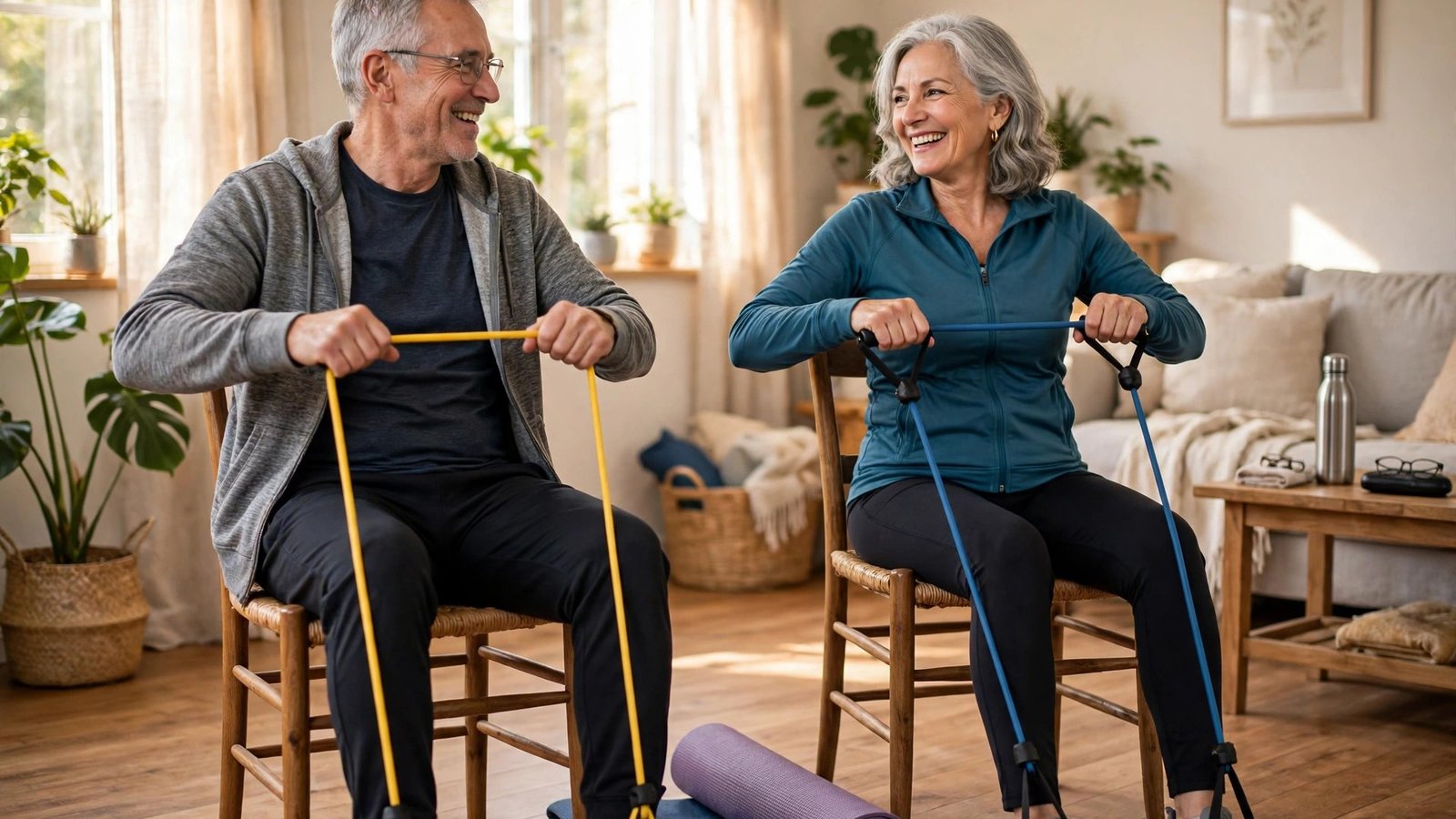
Sit on a chair, loop a resistance band around the soles of your feet, and hold one end in each hand. Sit tall, then pull your elbows back, squeezing your shoulder blades together, and return slowly. Strong mid-back muscles support good posture and make lifting and carrying easier.
Start with: 1 set of 10 repetitions with a light band. Easier: use a longer, lighter band. Harder: shorten the band or use a stronger one.
6. Calf raise — lower legs and balance
Stand behind a sturdy chair, hands lightly resting on the chair back. Rise onto the balls of your feet, hold for one second, then lower slowly. Strong calves help you push off when walking and climbing stairs, and they support balance.
Start with: 1 set of 10 repetitions. Easier: hold the chair firmly with both hands. Harder: do one leg at a time, or hold a light weight.
Finish each session with balance: stand on one foot for 10 seconds while holding the chair, then switch feet. Repeat twice on each side. This pairs your strength work with the balance training the CDC recommends.
Your first 4-week beginner plan
Two sessions a week, with at least one rest day between them, is the right starting point. A session should take 20 to 30 minutes including a warm-up. Walk for 5 minutes first — around the house or garden — and gently roll your shoulders and circle your ankles. Finish with 5 minutes of slow stretching for the muscles you worked.
| Week | Sessions | Sets | Reps | Rest | Focus |
|---|---|---|---|---|---|
| Week 1 | 2 sessions/week | 1 set per exercise | 8–10 reps | 60–90 sec rest | Learn the moves; use the easiest versions; stop if form breaks down |
| Week 2 | 2 sessions/week | 1–2 sets | 10–12 reps | 60 sec rest | Add a second set of the two moves that feel easiest |
| Week 3 | 2 sessions/week | 2 sets | 10–12 reps | 60 sec rest | Two sets of all six moves; try slightly heavier bands or weights |
| Week 4 | 2–3 sessions/week | 2 sets | 10–15 reps | 45–60 sec rest | If a third session fits, add it; keep at least one rest day between sessions |
How to know when to progress: when you can complete all repetitions of an exercise with good form and the last two repetitions feel only mildly challenging, it is time to make it slightly harder — add a repetition, a set, or a little weight. Increase only one thing at a time. Progress is usually fastest in the first 6 to 8 weeks, which is normal and encouraging; gains then continue more gradually.
A sample week: Monday — strength session (20 minutes) plus a 20-minute walk. Tuesday — a 30-minute walk. Wednesday — rest or gentle stretching. Thursday — strength session plus a 20-minute walk. Friday — a 30-minute walk. Saturday — a longer walk or a favourite activity such as gardening or dancing. Sunday — rest. That week meets the CDC’s 150 minutes of moderate activity and 2 days of strengthening.
Equipment: what you actually need
You do not need a gym. Here is what works at home, in order of usefulness:
- A sturdy, armless chair with a firm seat and no wheels. You already own the most important piece of equipment.
- Resistance bands (light and medium). Cheap, portable, and joint-friendly — a good first purchase, usually under $15 for a set.
- Light dumbbells (1, 2, 3 and 5 lb). Buy a pair of 2 lb and a pair of 3 lb to start; add heavier ones only when the light ones feel easy.
- Household substitutes: water bottles, soup cans, a bag of rice, or a backpack with books. Use them happily — the weight matters, not the brand.
- A yoga mat or rug for floor work, and supportive, non-slip shoes. Avoid exercising in socks on a smooth floor.

What to skip for now: heavy kettlebells, weight machines, and ankle weights. They have their place later, but they add risk without adding benefit for a beginner. If you join a gym later, a trainer can introduce machines safely. And be careful with “as seen on TV” gadgets that promise results without effort — no device replaces moving your muscles against resistance.
Common mistakes (and how to avoid them)
Most strength-training injuries in older beginners come from a handful of avoidable mistakes:
- Starting too heavy. The goal in week one is learning the movements, not testing your limits. Soreness that keeps you from your next session means you did too much.
- Holding your breath. Holding your breath during effort (the Valsalva manoeuvre) can spike blood pressure. Breathe out on the effort and in on the return — if you cannot talk while exercising, slow down.
- Rushing the repetitions. Fast, bouncy reps use momentum instead of muscle and strain joints. Two seconds up, two seconds down, every time.
- Skipping the warm-up. Cold muscles are stiffer and more injury-prone. Five minutes of easy walking is enough.
- Training only the arms. Arms are visible, but legs and hips do the work of daily life. Always include the sit-to-stand and calf raise.
- No rest days. Muscle rebuilds during rest, not during the workout. Train the same muscles on consecutive days only if you keep the effort very light — otherwise rest at least a day between sessions.
- Ignoring pain. “No pain, no gain” is wrong after 60. Discomfort from effort is normal; sharp, sudden, or joint pain is a stop signal.
- Poor posture during exercises. A rounded back during rows or presses loads the spine badly. If you cannot keep your back straight, lighten the weight.
Strength training with common health conditions
These are general pointers only. Your doctor or physical therapist can tailor them to you, and that advice comes first.
- Arthritis: Strengthening the muscles around a painful joint often reduces pain and stiffness over time. Use lighter weights, a full but comfortable range of motion, and warm up well. Avoid exercises that cause sharp joint pain, and consider water-based strength work or resistance bands, which are gentler on joints.
- Osteoporosis: Weight-bearing and resistance exercises are recommended to help slow bone loss, but avoid loaded forward bending and twisting of the spine (such as sit-ups with weights) and high-impact moves. Ask your doctor which exercises are safe for your bone density.
- Diabetes: Strength training can support blood-sugar control, but check your blood sugar before and after sessions when you start, and keep fast-acting glucose nearby if you use insulin or medicines that can cause low blood sugar.
- Heart disease or high blood pressure: Avoid heavy lifting and holding your breath, and keep weights light with more repetitions. A cardiac rehabilitation programme is the safest way to start if you have had a heart event.
- After a knee or hip replacement: Strength training is usually an important part of recovery, but the exercises, timing, and allowed movements depend on your surgeon’s instructions. Follow them exactly and work with a physical therapist.
- Balance problems or a history of falls: Always exercise next to a sturdy chair or countertop, keep a phone nearby, and consider your first sessions supervised. Our guide to balance problems after 50 explains the warning signs and simple tests worth knowing.
Recovery: sleep, protein and water
Strength training works because of what happens after the session. Muscles repair and grow stronger during rest — and three things support that repair:
- Sleep: aim for 7 to 8 hours. Sleep is when much of muscle repair happens. If sleep is a struggle, our guide to how much sleep you need after 50, 60 and 70 has a practical routine.
- Protein: older adults need more protein than younger adults to maintain muscle — most guidance suggests spreading protein across meals rather than eating it all at dinner. Good sources include eggs, Greek yoghurt, beans, lentils, fish, chicken, and tofu. If you take medicines or have kidney disease, ask your doctor about the right protein amount for you.
- Water: mild dehydration makes muscles tire faster and cramps more likely. Keep a glass of water nearby during sessions, and read our guide to dehydration in older adults for the warning signs many people miss.
Rest days are part of the programme, not a break from it. If you feel unusually tired or sore, take an extra rest day — your muscles will thank you.
Why strength training protects your independence
It is worth stepping back from sets and reps to remember what this is for. The strength to stand from a chair without using your arms is the strength to stay in your own home. The grip to open a jar is the strength to cook for yourself. The balance to recover from a stumble is the difference between a scare and a fracture. Strength training after 60 is not about looking athletic; it is about keeping the everyday abilities that make life yours.
It also protects against the muscle loss that makes other problems worse. Our guide to sarcopenia after 50 explains how muscle loss starts earlier than most people think — and how protein and strength work together to slow it. And because falls are the leading cause of injury for older adults in the U.S., the home-safety steps in our fall prevention checklist pair naturally with stronger legs: safer home plus stronger body is the best combination.
Start small, start this week, and be patient with yourself. Two short sessions a week, done consistently, will do more for you in three months than an intense week followed by a month off.
Frequently asked questions
1. How many days a week should seniors do strength training?
Two days a week is the guideline from the CDC and the National Institute on Aging, working all major muscle groups. Three days is fine once you are comfortable, as long as you rest at least a day between sessions that work the same muscles.
2. Is it safe to start strength training at 70 or 80 if I have never exercised?
For most healthy older adults, yes — with a doctor’s clearance first and a slow start using body weight, a chair, and light bands. Studies and clinical guidance show people in their 70s, 80s and beyond can still gain strength. Begin with the easiest versions of the six moves in this guide, and consider a few supervised sessions with a physical therapist.
3. What is the best strength exercise for seniors to start with?
The sit-to-stand from a sturdy chair. It strengthens the legs, hips and glutes you use every day, needs no equipment, and is easy to make easier or harder. Pair it with wall push-ups for the upper body and you have a complete beginner session.
4. Should seniors use weights or resistance bands?
Both work. Resistance bands are gentler on joints, cheaper, and easier to store, which makes them a good first choice. Light dumbbells are useful when you want a fixed, measurable weight. Many people use bands for some exercises and dumbbells for others.
5. How long does it take to see results from strength training after 60?
Most people notice everyday tasks feeling easier within 4 to 6 weeks, and measurable strength gains within 6 to 8 weeks of twice-weekly sessions. Early gains come mostly from your nervous system learning the movements; visible muscle changes take longer. Consistency matters more than intensity.
6. Is strength training safe with arthritis?
Often, yes — strengthening the muscles around an arthritic joint can reduce pain and improve function. Use lighter weights, move through a comfortable range, warm up well, and stop any exercise that causes sharp joint pain. Talk to your doctor or physical therapist about which movements suit your joints.
7. Can strength training help prevent falls?
Yes. Stronger leg and hip muscles, better balance, and faster reactions all reduce fall risk, which is why the CDC recommends combining strength and balance activities. Strength work alone is not enough — also check your home for trip hazards and have your vision and medicines reviewed.
8. Do I need to join a gym to strength train as a senior?
No. A home routine with a sturdy chair, resistance bands, and light dumbbells covers every major muscle group. A gym can be useful later for heavier weights and machines, and some Medicare Advantage plans include gym membership benefits — check your plan.
Conclusion
Strength training after 60 is one of the simplest, best-supported things you can do for your health. Two short sessions a week — six basic moves, a chair, and light resistance — can help you keep your muscle, protect your bones, steady your balance, and stay independent in the home and life you love. Start with the easiest versions, progress slowly, rest between sessions, and check with your doctor first if you have a health condition. The best time to start was years ago; the second-best time is this week.
Your next step: try the sit-to-stand and wall push-up today — just one set of each. If they feel comfortable, add the other four moves at your next session and follow the four-week plan above. And if this guide helped, share it with a friend or family member who could use a stronger start to their 60s, 70s, or 80s.





3 Comments