

Sarcopenia After 50: Protein, Strength and Early Warning Signs
Direct answer: Sarcopenia is the gradual loss of muscle mass, strength and function that comes with aging — and after 50 it is one of the most important, and most fixable, health risks you face. Muscle loss often starts in your 30s and speeds up after 50, but it is not inevitable decline: the two…
Direct answer: Sarcopenia is the gradual loss of muscle mass, strength and function that comes with aging — and after 50 it is one of the most important, and most fixable, health risks you face. Muscle loss often starts in your 30s and speeds up after 50, but it is not inevitable decline: the two things with the strongest evidence behind them are eating enough protein (about 1.0–1.2 grams per kilogram of body weight a day for healthy older adults) and doing resistance training two to three times a week. The earliest warning signs are practical ones you can spot at home — a weaker grip, needing your arms to stand up from a chair, slower walking, and more trouble with stairs. If you notice those, talk to your doctor, because muscle loss caught early responds far better than muscle loss ignored for years.
Important disclaimer: This article is general information only. It is not medical advice, and it does not replace advice from your doctor, physical therapist or registered dietitian. Higher protein intakes are not right for everyone — people with kidney disease or other conditions need individual guidance — and new exercise routines should be checked with your clinician first, especially if you have heart disease, joint problems or a history of falls. Talk to your doctor before changing your diet, starting supplements, or beginning a strength programme.
What Is Sarcopenia?
Sarcopenia is the medical term for age-related loss of skeletal muscle — not just the size of your muscles, but their strength and how well they work. It is diagnosed on three things together: low muscle mass, low muscle strength (such as grip strength), and poor physical performance (such as slow walking speed). Losing a little muscle with age is common; sarcopenia is when that loss becomes enough to affect daily life.
How common is it? Reviews of the research estimate sarcopenia affects roughly 6–22% of adults aged 65 and older, with the share rising steeply with each decade. And the process starts far earlier than most people realise: lean muscle mass typically declines by about 3–8% per decade after the age of 30, and the rate increases after 50 — especially in people who are inactive. Because the change is slow, many people do not notice it until a simple task suddenly feels hard.
That matters because muscle is not just about looking fit. Healthy muscle supports nearly everything that keeps you independent: walking and balance, blood sugar control, bone strength, joint protection, metabolism, and the ability to recover after illness or a fall. Losing muscle is linked to higher risks of falls and fractures, frailty, type 2 diabetes, hospital stays and loss of independence. MedlinePlus on sarcopenia describes it as a condition that develops slowly and is often missed until it causes a problem — which is exactly why early signs matter.
The encouraging news is that sarcopenia is one of the most treatable age-related conditions. Research consistently shows that adults over 60 — and even over 80 — can still build strength and improve function with the right combination of resistance exercise and protein. Your muscles keep responding to training throughout life; they just need a stronger signal than they did at 30.
Early Warning Signs of Sarcopenia
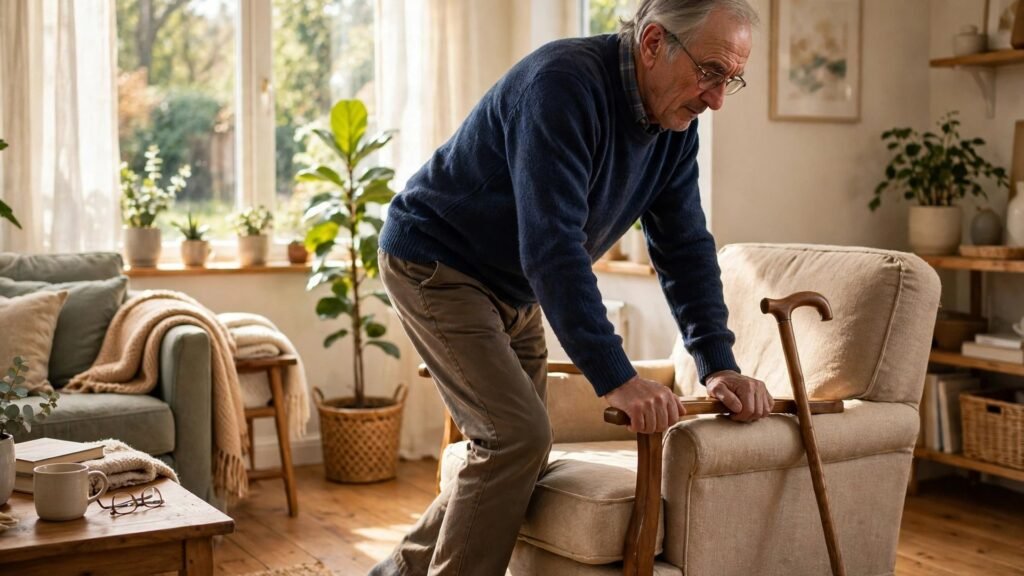
The first signs of muscle loss are usually subtle and easy to dismiss as “just getting older.” They are worth taking seriously, because they are also the stage when action works best.
1. Weaker grip strength. Jars that used to open easily now need two hands. Carrying a full grocery bag feels heavier than it did a year ago. Grip strength is one of the most studied early markers — clinicians measure it because it tracks closely with overall muscle strength and future health risk.
2. Trouble rising from a chair. If you now need to push off with your arms to stand up, or you rock forward to get momentum, that is a classic sign. A simple self-check used in clinics is the five-times sit-to-stand test: stand up and sit down five times as quickly as you safely can. Taking longer than about 15 seconds, or needing arm support, is a reason to mention it to your doctor.
3. Slower walking speed. A walking pace that has gradually slowed, or needing to rest on walks that used to be comfortable, can signal declining leg strength. Clinicians consider a usual walking speed below about 0.8 metres per second (roughly 1.8 miles per hour) a warning sign.
4. More difficulty with stairs. Needing the handrail every time, taking stairs one at a time, or avoiding stairs altogether often reflects weaker thigh and hip muscles rather than just tiredness.
5. More falls or near-falls. Weaker muscles react more slowly when you trip or lose balance, so the same stumble that you would once have caught turns into a fall. If you have fallen twice in the past year, or you feel unsteady, that is a medical conversation, not just a home-safety one — and our fall prevention checklist for seniors at home is a useful starting point while you arrange it.
6. Clothes fitting differently without weight change. As muscle is replaced by fat, your weight on the scale can stay almost the same while your waist grows and your arms and legs look thinner. Body composition changes matter more than the number on the scale.
7. Tiring faster and recovering more slowly. Muscles that are weaker fatigue sooner, and soreness after ordinary activity lingers longer. If a day of gardening now costs you two days of recovery, your muscles are telling you something.
None of these signs alone proves sarcopenia — many have other causes, from thyroid problems to low vitamin D to medication side effects. But two or more together, especially if they are new or worsening, deserve a doctor’s visit. A clinician can check grip strength and walking speed in minutes, and can look for treatable causes before anything is labelled sarcopenia.
Why Muscle Loss Speeds Up After 50
Muscle loss is not caused by one thing. It is the result of several age-related changes stacking up at once — and understanding them explains why the fix has to combine food and exercise, not just one or the other.
Anabolic resistance. This is the biggest piece of the puzzle. As we age, muscles become less sensitive to the signal that tells them to build new tissue after eating protein or exercising. A meal that would have triggered strong muscle building at 30 produces a weaker response at 70. That is why older adults need more protein per meal, not less, to get the same effect — a point we cover in detail below.
Less activity. The single largest avoidable driver. Muscles shrink quickly when they are not challenged: even a week or two of bed rest or very low activity during illness can cost an older adult a noticeable amount of strength, and it is regained far more slowly than it was lost. Retirement, driving everywhere, and a chair-based routine all quietly reduce the daily load on muscles.
Hormonal changes. Aging lowers levels of hormones involved in maintaining muscle, including testosterone, estrogen, growth hormone and insulin-like growth factor. These changes are gradual and normal, but they tilt the balance from building muscle toward breaking it down.
Chronic low-grade inflammation. Many long-term conditions — and aging itself — raise background inflammation, which speeds muscle breakdown. This is one reason sarcopenia is more common in people with diabetes, heart disease, COPD or arthritis.
Eating less protein. Appetite often falls with age, teeth and chewing become harder, and many older adults quietly drift toward toast, tea and soup — meals that are low in protein. Surveys repeatedly find a large share of adults over 65 eat well below the protein levels now recommended for muscle health.
Poor sleep and recovery. Sleep is when much of muscle repair happens. Short or broken sleep blunts the muscle-building response to protein and exercise, and low sleep is common after 60. If you are unsure how much rest you actually need, see our guide on how much sleep you need after 50.
How Much Protein Do You Need After 50?

If there is one number to remember from this article, it is this one. The Recommended Dietary Allowance (RDA) for protein is 0.8 grams per kilogram of body weight per day — but that figure was set to prevent deficiency in younger adults, not to maintain muscle in older ones. Expert groups that reviewed the evidence specifically for aging — the PROT-AGE Study Group and the European Society for Clinical Nutrition and Metabolism (ESPEN) — concluded that healthy older adults need at least 1.0–1.2 grams of protein per kilogram of body weight per day, and older adults who already have sarcopenia or frailty, or who are ill, need 1.2–1.5 grams per kilogram per day.
For a 70-kilogram (about 154-pound) person, that is roughly 70–84 grams of protein a day at the healthy range, versus just 56 grams at the old RDA. For an 80-kilogram (176-pound) person, it is 80–96 grams a day. The NIH Office of Dietary Supplements protein fact sheet is a reliable place to check protein contents of foods and the current guidance.
How much per meal matters as much as the daily total. Because of anabolic resistance, older muscles need a bigger single dose of protein to switch on muscle building — about 25–30 grams per meal, containing roughly 2.5–3 grams of the amino acid leucine. A typical pattern that fails is a carb-heavy breakfast (toast and coffee, maybe 5 grams of protein), a light lunch, and then almost all the day’s protein at dinner. Spreading protein across three or four meals, each with 25–30 grams, works far better.
What does 25–30 grams of protein look like in real food?
- 2 eggs plus a cup of Greek yogurt: about 28 grams
- A palm-sized piece of chicken or fish (about 100–120 grams cooked): about 25–30 grams
- A cup of cottage cheese: about 25 grams
- A cup of lentils plus a slice of cheese: about 25 grams
- A small can of tuna on wholegrain toast: about 28 grams
Leucine-rich foods are the most efficient. Leucine is the amino acid that most strongly triggers muscle building. The richest sources are animal proteins — whey, eggs, dairy, meat and fish — while plant proteins generally contain less leucine per gram, so vegetarians and vegans need larger portions or a mix of sources (beans plus grains, soy foods, lentils) to reach the same leucine level.
What about kidney disease? This is the most common worry, and it needs a careful answer. In healthy older adults without kidney disease, studies have not found that protein intakes of 1.2–1.5 g/kg a day harm the kidneys. But if you have chronic kidney disease, your doctor may need to limit protein — so this is a conversation to have with your clinician, not a number to apply on your own. Never start a high-protein diet or a protein supplement without checking first if you have kidney disease, liver disease or diabetes with kidney involvement.
Protein supplements: useful, not essential. If you cannot comfortably eat enough protein — because of appetite, chewing problems, cost or cooking difficulty — a whey protein powder or a ready-to-drink protein shake can help fill the gap. Research reviews find whey protein combined with resistance training gives some of the best results for muscle mass and strength. Choose a plain, third-party tested product (look for USP, NSF or Informed Sport on the label), keep the sugar low, and treat it as a supplement to real food, not a replacement for meals. A dietitian can help if eating enough is genuinely hard.
Strength Training: The Most Effective Treatment for Sarcopenia

If protein is the building material, resistance training is the instruction to build. Of everything studied for sarcopenia, progressive resistance training has the strongest and most consistent evidence — and it works at every age. Trials in adults in their 70s, 80s and even 90s show meaningful gains in strength, walking speed and independence after a few months of regular training. The National Institute on Aging exercise guidance recommends strength work as one of the four essential types of exercise for older adults, alongside balance, flexibility and endurance.
How much is enough? Two to three sessions a week, on non-consecutive days, is the standard recommendation. Each session should work the major muscle groups — legs, hips, back, chest, shoulders and arms — for about 30–45 minutes. That is the whole prescription, and it is far more achievable than most people expect.
What counts as resistance training? Anything that makes your muscles work against a load they are not used to: bodyweight exercises (chair squats, wall push-ups, calf raises), resistance bands, dumbbells, weight machines, or even heavy housework and gardening done with intent. The key word is progressive: the load should gradually increase over weeks, because muscles only adapt when the challenge grows.
A safe beginner routine you can start at home (check with your doctor first, and stop if you feel chest pain, severe dizziness or sharp joint pain):
- Chair squats — stand in front of a sturdy chair, lower yourself until you just touch the seat, then stand. 2 sets of 8–10.
- Wall push-ups — hands on a wall at shoulder height, bend your elbows and lean in, then push back. 2 sets of 8–10.
- Standing calf raises — hold a counter for balance, rise onto your toes, lower slowly. 2 sets of 10–12.
- Seated row with a resistance band — loop a band around your feet, pull the ends toward your waist. 2 sets of 10.
- Standing side leg lifts — hold a counter, lift one leg out to the side, lower slowly. 2 sets of 8 each side.
- Glute bridge — lying on your back, knees bent, lift your hips. 2 sets of 8–10.
Rest a minute between sets. Breathe out on the effort and never hold your breath. If an exercise hurts a joint (as opposed to the mild burn of a working muscle), swap it for another that targets the same area, or ask a physical therapist for an alternative.
Common fears, answered honestly. “I’m too old to start” — no, you are not; the oldest participants in strength studies are in their 90s and they gain strength. “I’ll hurt myself” — injury risk is low when you start light, progress slowly and use good form, and much lower than the risk of a fall caused by weak muscles. “I need a gym” — you do not; bodyweight and bands at home are enough to start, and a gym is a later step if you want it. “It won’t work without protein” — it works much better with enough protein, which is why this article pairs the two; exercise without adequate protein gives roughly half the benefit.
Balance training belongs in the same week. Strong legs help, but balance is a skill that needs practice: standing on one leg while brushing your teeth, heel-to-toe walking along a hallway, or a tai chi class. If balance is already a concern, read our guide to balance problems after 50 for a fuller set of tests and exercises.
The Other Daily Habits That Protect Muscle
Protein and strength training do most of the work, but several supporting habits add up.
Vitamin D. Muscle contains vitamin D receptors, and low vitamin D is linked to weaker muscles and more falls. Many older adults are deficient, especially in winter or if they rarely go outside. A blood test can check your level; do not take high doses without testing, because too much vitamin D is also harmful. See our guide on vitamin D for seniors for signs, testing and safe doses.
Omega-3 fats. There is growing evidence that omega-3 fatty acids (from oily fish or fish oil) modestly improve muscle protein synthesis and strength when combined with training. Two servings of oily fish a week — salmon, sardines, mackerel — is a reasonable food-first target. If you take blood thinners, check with your doctor before adding fish oil supplements.
Daily walking and movement. Walking alone will not build much muscle, but it keeps the muscles you have active, supports balance, and prevents the rapid losses that come from long sedentary stretches. Aim for regular movement across the day rather than one long sit followed by one short walk.
Sleep. Aim for 7–8 hours, on a regular schedule. Poor sleep raises the stress hormone cortisol, which breaks down muscle, and reduces the muscle-building response to food and exercise. If pain, snoring or frequent night waking is ruining your sleep, that is worth raising with your doctor.
Avoid long periods of bed rest. After illness or surgery, get moving again as soon as your doctor allows — even gentle walking and ankle pumps in bed count. Muscle lost during two weeks of bed rest can take months to rebuild.
Limit alcohol and stop smoking. Both accelerate muscle breakdown and blunt recovery. If you drink, keeping it well within recommended limits is one of the simplest muscle-protective steps there is.
Common Mistakes That Make Muscle Loss Worse
Eating too little overall. Many older adults under-eat without realising it, especially after a bereavement, illness or a move to living alone. Muscle cannot be maintained on too few calories, however good the protein percentage is. If your weight is drifting down without trying, that is a warning sign.
Crash dieting to lose weight. Rapid weight loss in older adults is typically one-quarter to one-third muscle. If you need to lose weight, do it slowly, keep protein high, and keep strength training — otherwise you can end up lighter but weaker and more fragile.
Doing only cardio. Walking, swimming and cycling are excellent for the heart and lungs, but they do not provide enough load to maintain muscle. Cardio plus strength training is the combination that works; cardio alone is not enough.
Waiting for a “good time” to start. The most common regret in this area is waiting. Muscle loss is gradual, and so is muscle gain — the people who benefit most are the ones who start with a modest routine now rather than a perfect plan next year.
Taking supplements instead of training. Protein powders, creatine and “muscle” supplements are widely marketed to older adults. None of them replaces resistance exercise. Creatine has reasonable evidence for modest strength gains in older adults who train, but it is not a treatment on its own, and it needs a doctor’s check if you have kidney problems or take medicines that affect the kidneys. Be sceptical of any product that promises to “reverse sarcopenia” without exercise — that claim is not supported by evidence.
Ignoring pain or dizziness. Joint pain that stops you exercising, dizziness on standing, or numbness in the legs are not normal aging — they are reasons to see a doctor, and they often have treatable causes that, once fixed, let you train again.
When to Talk to Your Doctor
See your doctor promptly if you notice sudden or rapid weakness, unexplained weight loss, frequent falls, difficulty swallowing, muscle pain that does not settle, or weakness on one side of the body — these can signal conditions beyond ordinary sarcopenia, including thyroid disease, vitamin B12 deficiency, medication side effects or neurological problems, and they need proper evaluation.
At a routine visit, it is worth raising muscle loss directly. A doctor can measure grip strength with a hand dynamometer, time your walking speed and your five-times sit-to-stand test, and check blood levels of vitamin D and B12 and thyroid function. In some cases they may refer you for a body-composition scan (DXA) or to a physical therapist for a personalised strength programme, or to a dietitian if eating enough protein is difficult. Bringing up muscle loss at your annual wellness visit or a health screening by age is a natural moment to do it.
A Simple Weekly Plan to Start This Week
You do not need to overhaul your life on Monday. This plan combines the two proven ingredients at a beginner level:
| Day | What to do |
|---|---|
| Monday | Strength session A (chair squats, wall push-ups, calf raises) — 30 minutes. Protein at every meal, aiming for 25–30 g. |
| Tuesday | 20–30 minute walk + 5 minutes of balance practice (one-leg stands holding a counter). |
| Wednesday | Rest or gentle stretching. Protein at every meal. |
| Thursday | Strength session B (band row, side leg lifts, glute bridge) — 30 minutes. |
| Friday | 20–30 minute walk + balance practice. |
| Saturday | Strength session A again, slightly harder (one extra set, or a thicker band). |
| Sunday | Rest, cook a protein-rich meal, plan next week’s meals. |
After four weeks, add a little load or a few more repetitions. After eight to twelve weeks, most people notice everyday tasks feeling easier — the chair, the stairs, the shopping bags. That is muscle coming back, and it is worth tracking: note your sit-to-stand time and your walking route each month so you can see the change.
The CDC physical activity guidance for older adults recommends at least 150 minutes of moderate activity a week plus muscle-strengthening on two or more days — this plan is built to reach exactly that.
Frequently Asked Questions
1. Is sarcopenia reversible after 60 or 70?
Muscle loss can be slowed substantially and partly reversed at any age, including after 70. Studies show older adults gain strength and muscle with resistance training and enough protein. What cannot usually be fully reversed is very advanced frailty, which is why starting early matters — but it is never too late to improve.
2. How much protein should a 70-year-old eat per day?
For a healthy older adult, expert guidance is 1.0–1.2 grams of protein per kilogram of body weight per day — roughly 70–84 grams for a 70-kg (154-lb) person — spread across meals at about 25–30 grams per meal. People with sarcopenia or illness may need 1.2–1.5 g/kg. Check with your doctor first if you have kidney disease.
3. What is the best exercise for sarcopenia?
Progressive resistance training — exercises against a load, such as chair squats, resistance bands, dumbbells or weight machines — done two to three times a week. Walking and balance work help, but they do not replace strength training for building muscle.
4. What are the first signs of muscle loss?
A weaker grip, needing your arms to rise from a chair, slower walking, more trouble with stairs, more falls or near-falls, and clothes fitting differently without weight change. Two or more of these together are worth mentioning to your doctor.
5. Can you build muscle after 50 without supplements?
Yes. Real food plus resistance training is the foundation, and most people can meet their protein needs from food. Supplements such as whey protein are a convenience for people who struggle to eat enough — they help, but they are not required and they never replace training.
6. Does walking help sarcopenia?
Walking helps maintain mobility, balance and general health, and it prevents the muscle loss that comes from inactivity. But walking alone provides too little load to build muscle. It works best combined with two to three weekly strength sessions.
7. How is sarcopenia diagnosed?
A clinician measures grip strength, walking speed and the five-times sit-to-stand test, and may check muscle mass with a DXA scan or bioelectrical impedance. Blood tests can rule out other causes such as low vitamin D, thyroid problems or B12 deficiency.
8. Is creatine safe for seniors?
Creatine has reasonable evidence for modest strength gains in older adults who are already resistance training, but it can affect the kidneys and interact with some medicines, so it should only be used after a discussion with your doctor — and it is not a substitute for protein or exercise.
Conclusion
Sarcopenia is common, it starts earlier than most people think, and it quietly steals the strength that independence depends on. But it is also one of the most treatable parts of aging. The evidence points to two things, done consistently: eat enough protein — about 1.0–1.2 grams per kilogram a day, spread across meals at 25–30 grams each — and do resistance training two to three times a week. Add in vitamin D if you are low, daily walking, good sleep and balance practice, and you have a plan that works at 55, 65 or 75.
Start this week, not next year. Try the chair-stand test today, add a protein food to your breakfast tomorrow, and do your first short strength session before the weekend. Small steps compound: in a few months the stairs, the shopping and the garden will feel easier — and that is not a small thing. It is your independence.
If you noticed any of the early warning signs in this article, book a check with your doctor and mention muscle loss by name. Bring this article’s numbers with you, ask about a grip-strength check, and ask whether your protein intake and exercise routine are enough for your age and health. And if this guide helped you, share it with a parent, partner or friend over 50 — the earlier they start, the more muscle they keep.
This article is general information only and is not medical advice. Talk to your doctor, physical therapist or registered dietitian before changing your diet or exercise routine, especially if you have kidney disease, heart disease or take prescription medicines.






5 Comments